BiRefNet
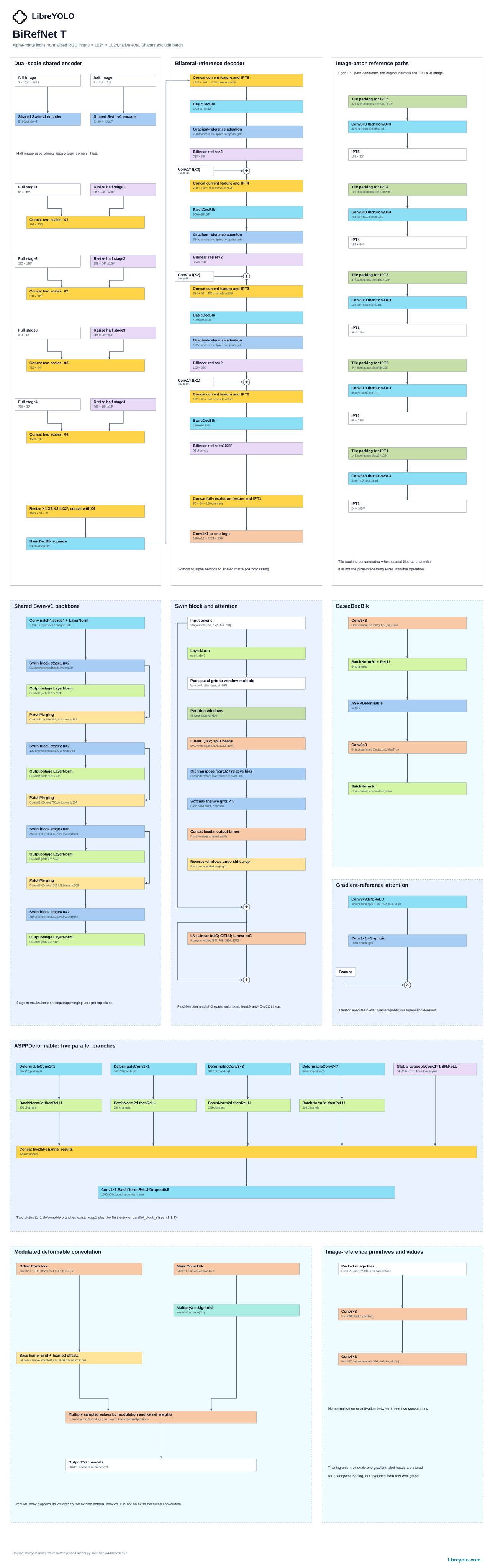
A bilateral-reference network that predicts a soft alpha matte separating a subject from its background. LibreYOLO ships inference and validation for BiRefNet's matte task.
- Tasks
- matte
- Sizes
- t, l at 1024 px
- Install
pip install libreyolo- Support tier
- Inference only, since v. Predict, validate and export only. Training features do not apply.
- Licenses
- Code MIT, weights MIT. Commercial use
Install
BiRefNet needs no optional extra. Everything it imports is in the base install.
pip install libreyoloPredict
Weights download from Hugging Face on first use and are cached locally.
from libreyolo import LibreYOLO, SAMPLE_IMAGE model = LibreYOLO("LibreBiRefNetl-matte.pt")result = model(SAMPLE_IMAGE, save=True) matte = result.matteprint(matte.array.shape, matte.array.dtype)libreyolo predict model=LibreBiRefNetl-matte.pt source=https://raw.githubusercontent.com/LibreYOLO/libreyolo/release/libreyolo/assets/parkour.jpg save=Truefrom libreyolo import LibreYOLO, SAMPLE_IMAGE model = LibreYOLO("LibreBiRefNetl-matte.pt")result = model(SAMPLE_IMAGE) # RGBA (H, W, 4) uint8: source RGB plus the matte as an alpha channel.rgba = result.cutout()result.save("subject.png")A matte result carries no boxes; result.matte is a dense (H, W)
float32 array in [0, 1], 1 fully foreground and 0 fully background. Unlike a
binary mask, the soft matte keeps anti-aliased edge detail such as hair and
fur. result.cutout() composites the source image with that alpha channel
into an RGBA array, and result.save(path) (or save=True on the predict
call) writes it straight to a transparent-background PNG. The model runs at a
fixed native 1024x1024 canvas; a different resolution is not supported,
because the Swin backbone's relative-position tables are tied to it, and a
mismatch interpolates them badly rather than raising an error. See
prediction for sources, streaming and result handling.
Variants
One published checkpoint, l, the Swin-L tier BiRefNet-general model and the
quality default upstream. The family's code also supports a Swin-T lite tier,
t, but no LibreYOLO conversion of it is published yet.
Validate
val() reports two metrics over a paired image/matte folder, both in
[0, 1] and independent of resolution: MAE, the mean absolute error against
the ground-truth alpha (lower is better), and S-measure (Fan et al., ICCV
2017), a structural similarity that credits preserving the subject's shape and
holes, which pixel MAE alone misses (higher is better). Validation drives the
model's own predict, so it uses the family's exact preprocessing.
from libreyolo import LibreYOLO model = LibreYOLO("LibreBiRefNetl-matte.pt") # A directory containing images/ and an auto-detected matte directory# (mattes/, matte/, gt/, masks/, mask/ or alpha/) also works in place# of a dataset YAML.metrics = model.val(data="my-matte-dataset/") print(metrics["metrics/MAE"])print(metrics["metrics/Smeasure"])Validation is inference-only; fine-tuning is a documented follow-up rather than a shipped feature (see Predict for the exact resolution constraint that any future trainer would inherit).
Export
| Task | ONNX | TorchScript | ExecuTorch | TensorRT | OpenVINO | Paddle | MNN | RKNN | ncnn | TFLite | CoreML | Core AI |
|---|---|---|---|---|---|---|---|---|---|---|---|---|
| matte | matte to ONNX: supported | matte to TorchScript: supported | matte to ExecuTorch: not supported | matte to TensorRT: not supported | matte to OpenVINO: not supported | matte to Paddle: not supported | matte to MNN: not supported | matte to RKNN: not supported | matte to ncnn: not supported | matte to TFLite: not supported | matte to CoreML: not supported | matte to Core AI: not supported |
An exported artifact loads back through LibreYOLO() on its file suffix, so a
.onnx file behaves like a checkpoint and returns the same Results.
TorchScript is the validated path; ONNX conversion runs but has not cleared
the same parity bar. Export lists the arguments every format
accepts and the extras a few of them add.
from libreyolo import LibreYOLO model = LibreYOLO("LibreBiRefNetl-matte.pt")model.export(format="onnx")libreyolo export model=LibreBiRefNetl-matte.pt format=onnxfrom libreyolo import LibreYOLO, SAMPLE_IMAGE # The factory routes on the file suffix, so an exported artifact loads# like any checkpoint and returns the same Results object.model = LibreYOLO("LibreBiRefNetl-matte.onnx")result = model(SAMPLE_IMAGE) print(result.matte.array.shape)Checkpoints
Every published weight file for this family.
| File | Input (px) | Weights license |
|---|---|---|
| matte | ||
| LibreBiRefNetl-matte.pt | mit | |
Every file above exists in the LibreYOLO org today and downloads on first use.
Licensing
Check the license on the Hugging Face repository of the specific weights you download. Every checkpoint in the LibreYOLO org carries one, and they are not always the same across a family. That repository is the authoritative source; the summary below describes what applied when this page was last verified.
This is a description of the licenses involved, not legal advice. If the answer matters commercially, read the licenses yourself and take your own counsel.
- Original work
- BiRefNet, Nankai University
- Upstream license
- MIT
- Upstream source
- github.com/ZhengPeng7/BiRefNet
- LibreYOLO code
- MIT
- Weights
- MIT, republished at huggingface.co/LibreYOLO
- Interpretation
- MIT is a permissive license, so these weights can be used in commercial and closed-source products. The one standing obligation is to keep the license text and copyright notice with any copy you redistribute. It places no condition on your own application code. LibreYOLO's checkpoint is a format conversion of the official pretrained BiRefNet-general weights (the Swin-L, quality-default tier), with the learned parameters unchanged; fine-tuning is not wired into this library in v1, so there is no LibreYOLO-trained variant to license separately.
Citation
@article{zheng2024birefnet,
  title={Bilateral Reference for High-Resolution Dichotomous Image Segmentation},
  author={Zheng, Peng and Gao, Dehong and Fan, Deng-Ping and Liu, Li and Laaksonen, Jorma and Ouyang, Wanli and Sebe, Nicu},
  journal={CAAI Artificial Intelligence Research},
  volume = {3},
  pages = {9150038},
  year={2024}
}
Copied from the authors' citation block at github.com/ZhengPeng7/BiRefNet#citation.