YOLOv7
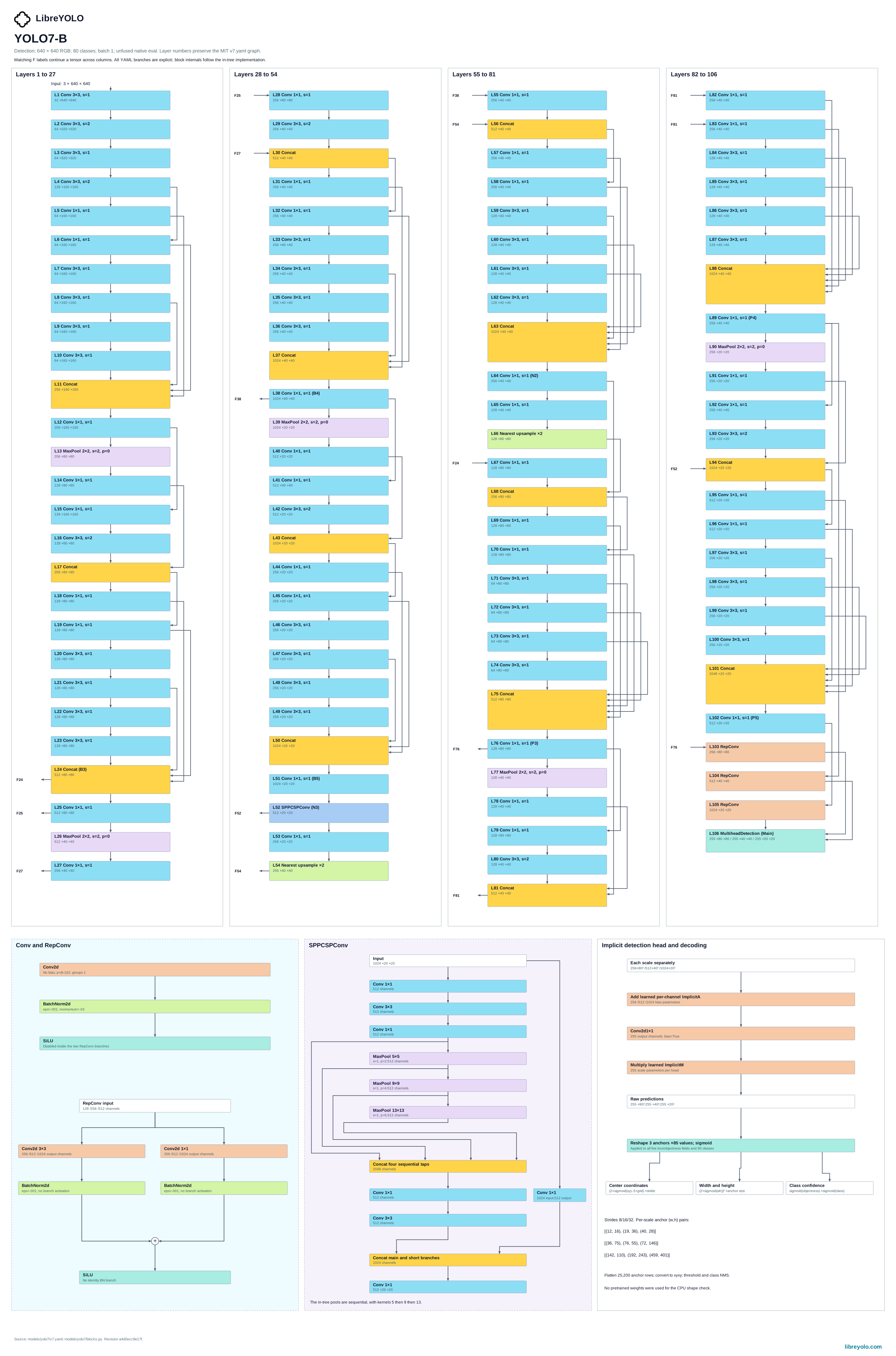
YOLOv7 is an anchor-based, single-stage detector whose head adds learned implicit-knowledge offsets before the final convolution. LibreYOLO supports its single published size for detection.
- Tasks
- detection
- Sizes
- b at 640 px
- Install
pip install libreyolo- Support tier
- Supported, since v. Supporting trainables: kept green in CI, features land opportunistically.
- Licenses
- Code MIT, weights MIT. Commercial use
Install
YOLOv7 needs no extra beyond the base package.
pip install libreyoloPredict
Weights download from Hugging Face on first use and are cached locally.
from libreyolo import LibreYOLO, SAMPLE_IMAGE model = LibreYOLO("LibreYOLO7b.pt")result = model(SAMPLE_IMAGE, save=True) for box in result.boxes: print(box.cls, box.conf, box.xyxy)libreyolo predict model=LibreYOLO7b.pt source=https://raw.githubusercontent.com/LibreYOLO/libreyolo/release/libreyolo/assets/parkour.jpg save=TrueThe returned Results object is the one every family returns, so swapping in a
different detector is a one line change. conf sets the confidence threshold
and iou the NMS threshold applied after the anchor-based head is decoded. See
prediction for sources, streaming and result handling.
Variants
LibreYOLO ships one size, b. Upstream publishes a single YOLOv7 model, so
there is no size to choose between.
Train
from libreyolo import LibreYOLO model = LibreYOLO("LibreYOLO7b.pt")model.train(data="my-dataset.yaml", epochs=300, imgsz=640, batch=16, lr0=0.01)libreyolo train model=LibreYOLO7b.pt data=my-dataset.yaml \ epochs=300 imgsz=640 batch=16 lr0=0.01from libreyolo import LibreYOLO7 # pretrained=True always loads the published LibreYOLO7b.pt checkpoint,# regardless of what this instance was constructed with. Constructing# the class directly, rather than through LibreYOLO(), starts with no# weights loaded at all.model = LibreYOLO7(None, size="b")model.train(data="my-dataset.yaml", epochs=300, pretrained=True)pretrained is read, unlike the no-op of the same name on some other
families here: pass True to warm-start from the published LibreYOLO7b.pt
checkpoint (auto-downloaded), or a path or name for anything else. That
published checkpoint is 80-class COCO, so requesting it on a model already
rebuilt for a different class count first rebuilds back to 80, loads it, then
transfers every shape-matching tensor into the target head count once the
dataset's class count is read. resume=True cannot be combined with
pretrained. Left at the default None, training continues from whatever
the model was constructed with, or from a random initialization if nothing
was loaded.
Left alone otherwise, the trainer runs 300 epochs at lr0=0.01 with SGD
momentum 0.937, a 3-epoch warmup, and the same SimOTA assignment and final
15-epoch no-augmentation phase YOLOX uses, adapted to the anchor-based head.
The one difference: YOLOX adds an L1 box-regression refinement during those
final epochs that v7 skips, because v7's SimOTA loss carries no raw-offset L1
branch to refine.
See training for datasets, augmentation, multi-GPU and loggers.
Validate
val() returns a dictionary of metrics/ keys covering precision, recall,
mAP 50 and mAP 50-95, measured against any dataset in the format you trained on.
from libreyolo import LibreYOLO model = LibreYOLO("LibreYOLO7b.pt")metrics = model.val(data="my-dataset.yaml") print(metrics["metrics/mAP50-95"])print(metrics["metrics/mAP50"])libreyolo val model=LibreYOLO7b.pt data=my-dataset.yamlExport
| Task | ONNX | TorchScript | ExecuTorch | TensorRT | OpenVINO | Paddle | MNN | RKNN | ncnn | TFLite | CoreML | Core AI |
|---|---|---|---|---|---|---|---|---|---|---|---|---|
| Detection | Detection to ONNX: supported | Detection to TorchScript: supported | Detection to ExecuTorch: supported | Detection to TensorRT: supported | Detection to OpenVINO: supported | Detection to Paddle: not supported | Detection to MNN: not supported | Detection to RKNN: not supported | Detection to ncnn: supported | Detection to TFLite: not supported | Detection to CoreML: not supported | Detection to Core AI: supported |
An exported artifact loads back through LibreYOLO() on its file suffix, so a
.onnx or .engine file behaves like a checkpoint and returns the same
Results. Running the graph in a bare runtime, with no LibreYOLO installed, is
also supported, but then preprocessing and postprocessing are yours to write.
from libreyolo import LibreYOLO model = LibreYOLO("LibreYOLO7b.pt")model.export(format="onnx", imgsz=640)model.export(format="tensorrt", imgsz=640, half=True)libreyolo export model=LibreYOLO7b.pt format=onnx imgsz=640libreyolo export model=LibreYOLO7b.pt format=tensorrt imgsz=640 half=Truefrom libreyolo import LibreYOLO, SAMPLE_IMAGE # The factory routes on the file suffix, so an exported artifact loads# like any checkpoint and returns the same Results object.model = LibreYOLO("LibreYOLO7b.onnx")result = model(SAMPLE_IMAGE) print(result.boxes.xyxy)Checkpoints
Every published weight file for this family.
| File | Input (px) | Weights license |
|---|---|---|
| Detection | ||
| LibreYOLO7b.pt | 640 | mit |
Every file above exists in the LibreYOLO org today and downloads on first use.
Licensing
Check the license on the Hugging Face repository of the specific weights you download. Every checkpoint in the LibreYOLO org carries one, and they are not always the same across a family. That repository is the authoritative source; the summary below describes what applied when this page was last verified.
This is a description of the licenses involved, not legal advice. If the answer matters commercially, read the licenses yourself and take your own counsel.
- Original work
- YOLOv7, MultimediaTechLab
- Upstream license
- MIT
- Upstream source
- github.com/MultimediaTechLab/YOLO
- LibreYOLO code
- MIT
- Weights
- MIT, republished at huggingface.co/LibreYOLO
- Interpretation
- MIT is a permissive license, so these weights can be used in commercial and closed-source products. The one standing obligation is to keep the license text and the copyright notice, Kin-Yiu Wong and Hao-Tang Tsui, with any copy you redistribute. It places no condition on your own application code, and a model you train yourself on your own data is yours. The port follows the authors' MIT re-release of YOLOv7, not the GPL-3.0 WongKinYiu/yolov7 repository that carries the same model, so the permissive terms come from the source LibreYOLO actually derives from.
Citation
@inproceedings{wang2022yolov7,
      title={{YOLOv7}: Trainable Bag-of-Freebies Sets New State-of-the-Art for Real-Time Object Detectors},
      author={Wang, Chien-Yao and Bochkovskiy, Alexey and Liao, Hong-Yuan Mark},
      year={2023},
      booktitle={Proceedings of the IEEE/CVF Conference on Computer Vision and Pattern Recognition (CVPR)},
}
Copied from the authors' citation block at github.com/MultimediaTechLab/YOLO#citations.