Qwen3-VL
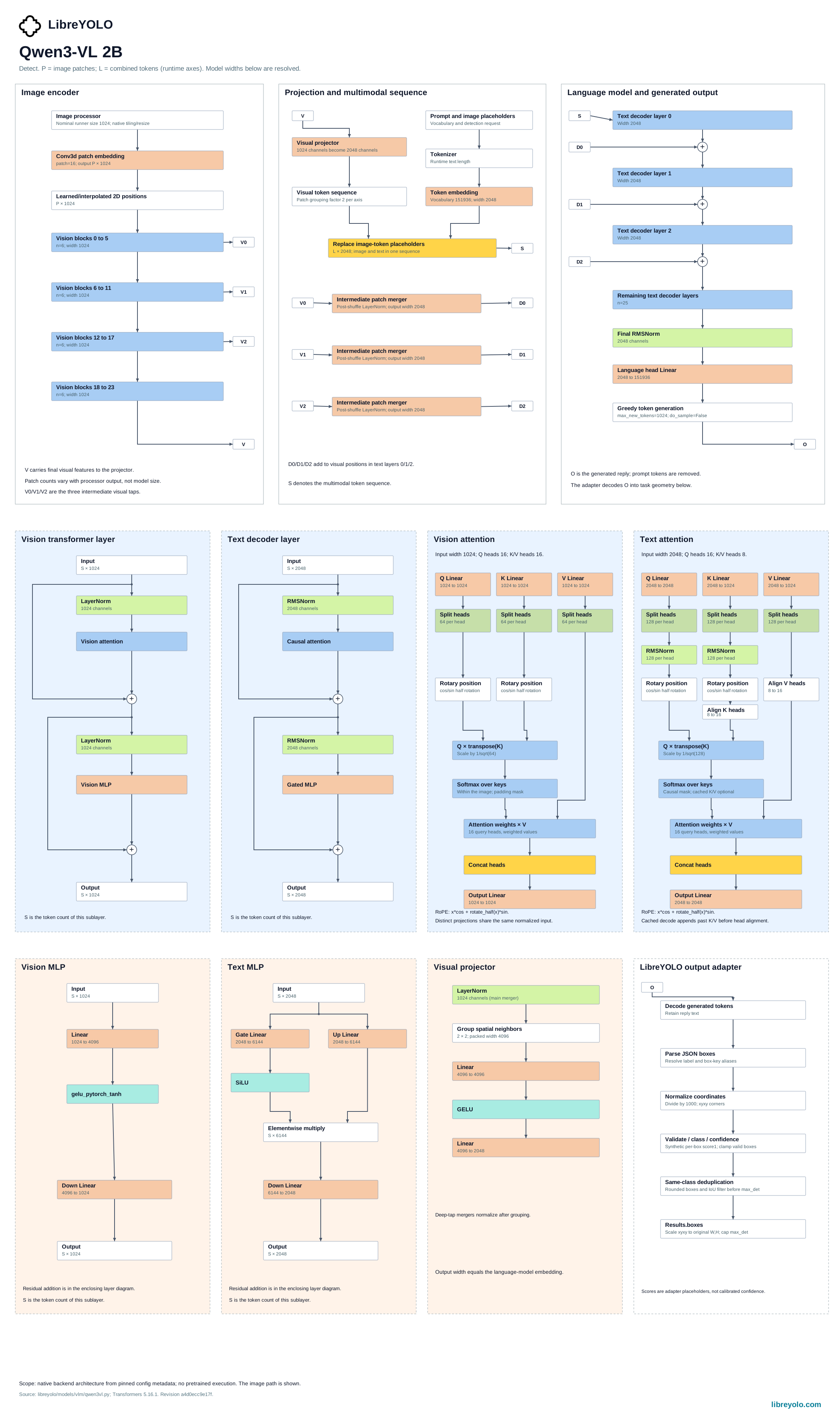
Qwen3-VL is Alibaba's vision-language model with native 2D grounding. LibreYOLO wraps it as an open-vocabulary object detector and exposes its free-form chat directly: supply a class list to detect, or ask it a question.
- Tasks
- detection
- Sizes
- 2b, 4b, 8b at 1024 px
- Install
pip install libreyolo- Support tier
- Sibling tier, since v. A separate product surface with its own factory and contract.
- Licenses
- Code MIT, weights Apache-2.0. Commercial use
Install
Qwen3-VL belongs to LibreYOLO's VLM-as-detector tier, a separate product
surface from the checkpoint-based families with its own factory. It needs the
vlm extra.
pip install "libreyolo[vlm]"Predict
Weights download from Hugging Face on first use and are cached locally.
LibreVLM() called with no argument defaults to Qwen3-VL-4B.
from libreyolo import LibreVLM, SAMPLE_IMAGE model = LibreVLM("qwen3-vl-4b")model.set_classes(["forklift", "pallet", "safety vest"])result = model.predict(SAMPLE_IMAGE, save=True) for box in result.boxes: print(box.cls, box.conf, box.xyxy)from libreyolo import LibreVLM, SAMPLE_IMAGE model = LibreVLM("qwen3-vl-4b") # The escape hatch beneath the detection convenience: any question,# not just a bounding-box query.answer = model.chat(SAMPLE_IMAGE, "How many people are wearing a safety vest?")print(answer)This family loads through the LibreVLM() factory, not LibreYOLO(): VLM
families declare no checkpoint loader, so the file-suffix routing described on
other model pages does not apply here. set_classes() sets the vocabulary
Qwen3-VL is asked to find; it is sticky, so it stays in effect across every
later predict()/track() call until you set it again. Every detection
carries the same placeholder confidence, so conf filtering is all-or-nothing
rather than a ranking; iou does have an effect for this family, dropping a
later same-class box once it overlaps an already-kept one past the threshold,
since a repeating generator can otherwise emit near-duplicate boxes for one
object. Unlike Florence-2 and Kosmos-2, Qwen3-VL also answers free-form
questions through chat(), the same escape hatch documented on the LibreVLM
factory. LibreYOLO's CLI does not cover this tier: there is no
libreyolo predict model=... form for it. See prediction for
sources, streaming and result handling.
Variants
Three sizes: Qwen3-VL-2B-Instruct, Qwen3-VL-4B-Instruct and Qwen3-VL-8B-Instruct,
loaded as LibreVLM("qwen3-vl-2b"), LibreVLM("qwen3-vl-4b") and
LibreVLM("qwen3-vl-8b"). All three declare a nominal 1024 px input, but the
Qwen processor's own smart-resize decides the actual canvas passed to the
network, so that figure is not a fixed operating resolution the way it is for
the other families on this site. LibreYOLO has not published a benchmark
comparing accuracy across the three sizes.
LibreYOLO does not train, validate or export Qwen3-VL: train(), val() and
export() all raise NotImplementedError for every family in this tier (see
the support tier above). Fine-tune Qwen3-VL upstream and load the resulting
weights if you need a custom vocabulary baked in; check predict() output by
eye instead of a COCO-style validation pass, since every detection carries the
same placeholder confidence.
Licensing
Check the license on the Hugging Face repository of the specific weights you download. Every checkpoint in the LibreYOLO org carries one, and they are not always the same across a family. That repository is the authoritative source; the summary below describes what applied when this page was last verified.
This is a description of the licenses involved, not legal advice. If the answer matters commercially, read the licenses yourself and take your own counsel.
- Original work
- Qwen3-VL, Alibaba (Qwen Team)
- Upstream license
- Apache-2.0
- Upstream source
- github.com/QwenLM/Qwen3-VL
- LibreYOLO code
- MIT
- Weights
- Apache-2.0, distributed by their authors. LibreYOLO does not host or mirror them.
- Interpretation
- Apache-2.0 is a permissive license, so these weights can be used in commercial and closed-source products. It asks you to keep its license text and attribution notices with any copy of the weights you redistribute, and it grants a patent license. All three sizes LibreYOLO downloads, Qwen3-VL-2B-Instruct, Qwen3-VL-4B-Instruct and Qwen3-VL-8B-Instruct, carry this license on their Hugging Face repository.
Citation
@article{Qwen3-VL,
      title={Qwen3-VL Technical Report},
      author={Shuai Bai and Yuxuan Cai and Ruizhe Chen and Keqin Chen and Xionghui Chen and Zesen Cheng and Lianghao Deng and Wei Ding and Chang Gao and Chunjiang Ge and Wenbin Ge and Zhifang Guo and Qidong Huang and Jie Huang and Fei Huang and Binyuan Hui and Shutong Jiang and Zhaohai Li and Mingsheng Li and Mei Li and Kaixin Li and Zicheng Lin and Junyang Lin and Xuejing Liu and Jiawei Liu and Chenglong Liu and Yang Liu and Dayiheng Liu and Shixuan Liu and Dunjie Lu and Ruilin Luo and Chenxu Lv and Rui Men and Lingchen Meng and Xuancheng Ren and Xingzhang Ren and Sibo Song and Yuchong Sun and Jun Tang and Jianhong Tu and Jianqiang Wan and Peng Wang and Pengfei Wang and Qiuyue Wang and Yuxuan Wang and Tianbao Xie and Yiheng Xu and Haiyang Xu and Jin Xu and Zhibo Yang and Mingkun Yang and Jianxin Yang and An Yang and Bowen Yu and Fei Zhang and Hang Zhang and Xi Zhang and Bo Zheng and Humen Zhong and Jingren Zhou and Fan Zhou and Jing Zhou and Yuanzhi Zhu and Ke Zhu},
	  journal={arXiv preprint arXiv:2511.21631},
      year={2025}
}
Copied from the authors' citation block at github.com/QwenLM/Qwen3-VL#citation.