Swin Transformer
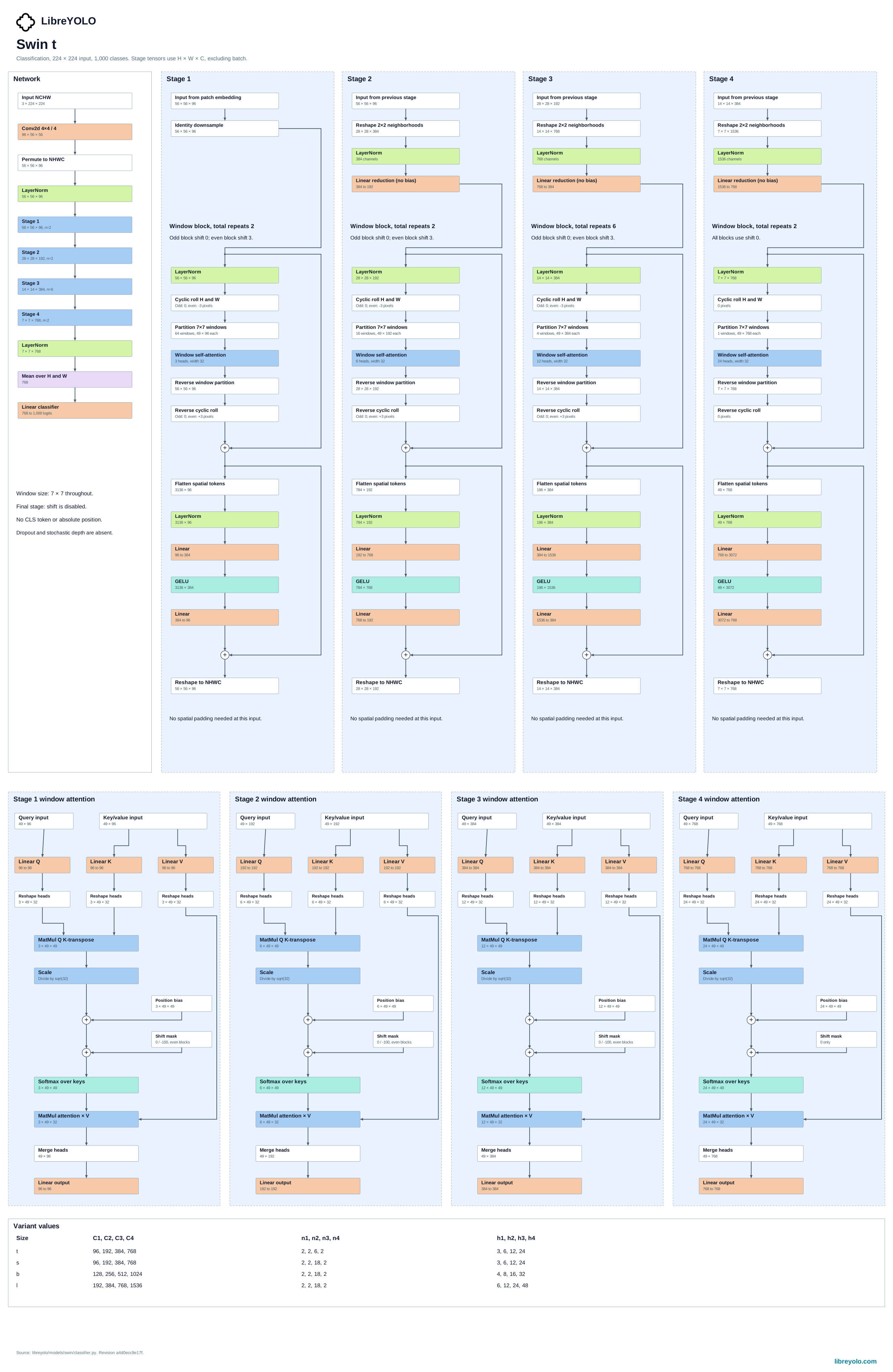
Swin Transformer V1: a hierarchical vision transformer that computes attention inside shifted local windows instead of over the whole image. LibreYOLO ships four sizes for image classification.
- Tasks
- classify
- Sizes
- t, s, b, l at 224 px
- Install
pip install libreyolo- Support tier
- Inference only, since v. Predict, validate and export only. Training features do not apply.
- Licenses
- Code Apache-2.0, weights MIT. Commercial use
Install
Swin needs no optional extra. Everything it imports is in the base install.
pip install libreyoloPredict
Weights download from Hugging Face on first use and are cached locally.
from libreyolo import LibreYOLO, SAMPLE_IMAGE model = LibreYOLO("LibreSwint-cls.pt")result = model(SAMPLE_IMAGE, save=True) probs = result.probsprint(probs.top1, probs.top1conf)print(probs.top5, probs.top5conf)libreyolo predict model=LibreSwint-cls.pt source=https://raw.githubusercontent.com/LibreYOLO/libreyolo/release/libreyolo/assets/parkour.jpg save=TrueA classifier returns result.probs instead of result.boxes: top1
and top5 give class indices, top1conf and top5conf give their
confidences. Every size is fixed to a 224px input, because the final attention
stage is built for that resolution; predict, validate and export all raise if
you pass a different imgsz. See prediction for sources,
streaming and result handling.
Variants
Four sizes, tiny through large, built from the same shifted-window tower and differing in embedding width and stage depth. Large is pretrained on ImageNet-22k and fine-tuned on ImageNet-1k; the other three are trained on ImageNet-1k directly. LibreYOLO ships this family inference-only: prediction, ImageNet-style top-1/top-5 validation and export are supported, and the upstream ImageNet training recipe is not implemented.
Validate
val() runs against an ImageFolder-style split (a directory with train/ and
val/ subfolders, one folder per class) and returns top-1 and top-5 accuracy.
from libreyolo import LibreYOLO model = LibreYOLO("LibreSwint-cls.pt") # data is a directory root with train/ and val/ class-folder splits# (ImageFolder layout), not a dataset YAML.metrics = model.val(data="imagenet-1k/") print(metrics["metrics/accuracy_top1"])print(metrics["metrics/accuracy_top5"])libreyolo val model=LibreSwint-cls.pt data=imagenet-1k/Export
| Task | ONNX | TorchScript | ExecuTorch | TensorRT | OpenVINO | Paddle | MNN | RKNN | ncnn | TFLite | CoreML | Core AI |
|---|---|---|---|---|---|---|---|---|---|---|---|---|
| classify | classify to ONNX: supported | classify to TorchScript: supported | classify to ExecuTorch: supported | classify to TensorRT: supported | classify to OpenVINO: supported | classify to Paddle: not supported | classify to MNN: not supported | classify to RKNN: not supported | classify to ncnn: supported | classify to TFLite: not supported | classify to CoreML: not supported | classify to Core AI: not supported |
An exported artifact loads back through LibreYOLO() on its file suffix, so a
.onnx or .engine file behaves like a checkpoint and returns the same
Results. Export lists the arguments every format accepts and
the extras a few of them add.
from libreyolo import LibreYOLO model = LibreYOLO("LibreSwint-cls.pt")model.export(format="onnx")model.export(format="tensorrt", half=True)libreyolo export model=LibreSwint-cls.pt format=onnxlibreyolo export model=LibreSwint-cls.pt format=tensorrt half=Truefrom libreyolo import LibreYOLO, SAMPLE_IMAGE # The factory routes on the file suffix, so an exported artifact loads# like any checkpoint and returns the same Results object.model = LibreYOLO("LibreSwint-cls.onnx")result = model(SAMPLE_IMAGE) print(result.probs.top1)Checkpoints
Every published weight file for this family.
| File | Input (px) | Weights license |
|---|---|---|
| classify | ||
| LibreSwint-cls.pt | 224 | mit |
| LibreSwins-cls.pt | 224 | mit |
| LibreSwinb-cls.pt | 224 | mit |
| LibreSwinl-cls.pt | 224 | mit |
Every file above exists in the LibreYOLO org today and downloads on first use.
Licensing
Check the license on the Hugging Face repository of the specific weights you download. Every checkpoint in the LibreYOLO org carries one, and they are not always the same across a family. That repository is the authoritative source; the summary below describes what applied when this page was last verified.
This is a description of the licenses involved, not legal advice. If the answer matters commercially, read the licenses yourself and take your own counsel.
- Original work
- Swin Transformer, Microsoft Research
- Upstream license
- MIT
- Upstream source
- github.com/microsoft/Swin-Transformer
- LibreYOLO code
- MIT
- Weights
- MIT, republished at huggingface.co/LibreYOLO
- Interpretation
- MIT is a permissive license, so these weights can be used in commercial and closed-source products. It asks only that you keep the license text and copyright notice with any copy you redistribute, and it carries no explicit patent grant. LibreYOLO's runtime code for this family is a derived port of the Apache-2.0 timm Swin implementation (Ross Wightman, huggingface/pytorch-image-models), kept parameter-name compatible so the tensors load unchanged; the four released Tiny/Small/Base/Large checkpoints are Microsoft's own MIT-licensed patch-4/window-7 classifiers. Code and weights therefore sit under two different permissive licenses, both of which allow commercial use.
Citation
@inproceedings{liu2021Swin,
  title={Swin Transformer: Hierarchical Vision Transformer using Shifted Windows},
  author={Liu, Ze and Lin, Yutong and Cao, Yue and Hu, Han and Wei, Yixuan and Zhang, Zheng and Lin, Stephen and Guo, Baining},
  booktitle={Proceedings of the IEEE/CVF International Conference on Computer Vision (ICCV)},
  year={2021}
}
Copied from the authors' citation block at github.com/microsoft/Swin-Transformer#citing-swin-transformer.