SwinIR
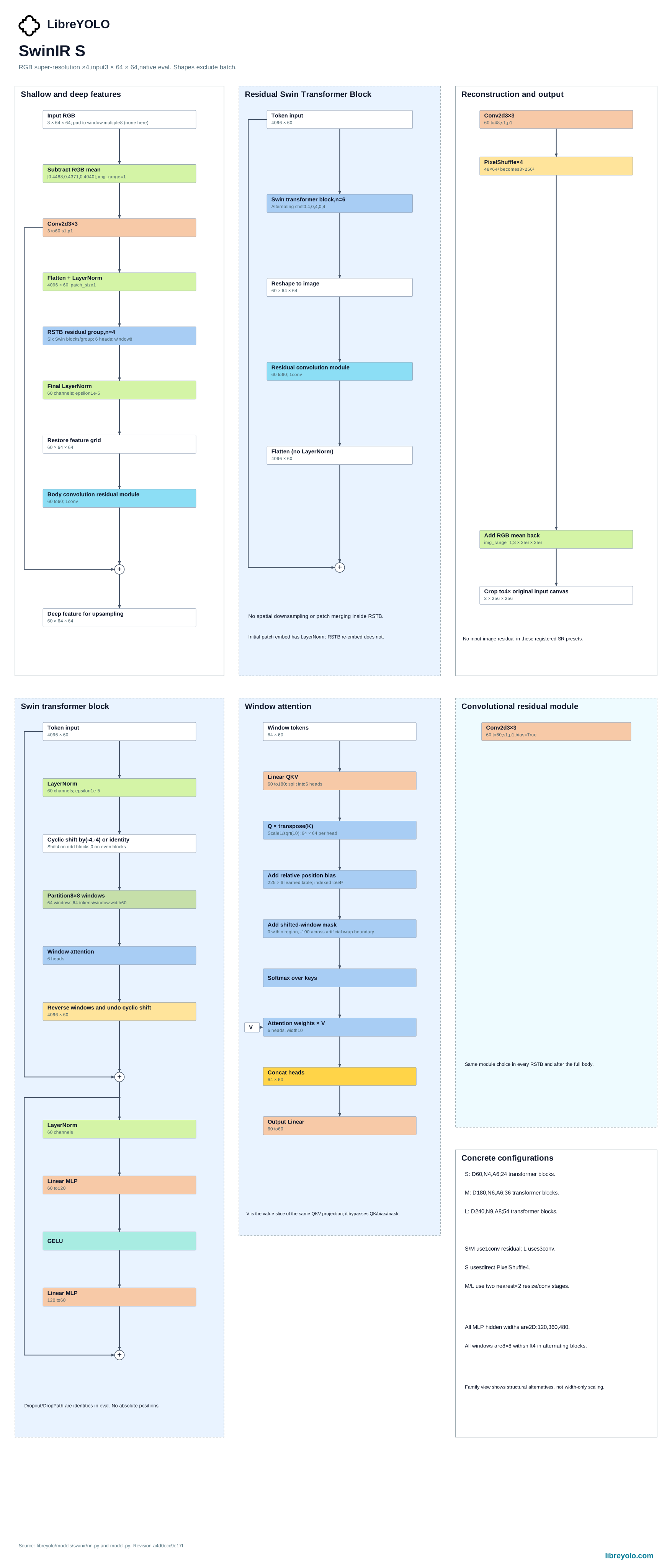
A Swin Transformer network for image restoration. LibreYOLO ships inference and validation for its 4x super-resolution checkpoints: the official lightweight, real-world medium and real-world large generators.
- Tasks
- restore
- Sizes
- s, m, l at 64 px
- Install
pip install libreyolo- Support tier
- Inference only, since v. Predict, validate and export only. Training features do not apply.
- Licenses
- Code Apache-2.0, weights Apache-2.0. Commercial use
Install
SwinIR needs no optional extra. Everything it imports is in the base install.
pip install libreyoloPredict
Weights download from Hugging Face on first use and are cached locally.
from libreyolo import LibreYOLO, SAMPLE_IMAGE model = LibreYOLO("LibreSwinIRm-restore.pt")result = model(SAMPLE_IMAGE, save=True) restored = result.restoredprint(restored.array.shape, restored.array.dtype)libreyolo predict model=LibreSwinIRm-restore.pt source=https://raw.githubusercontent.com/LibreYOLO/libreyolo/release/libreyolo/assets/parkour.jpg save=Truefrom libreyolo import LibreYOLO model = LibreYOLO("LibreSwinIRl-restore.pt") # tile splits the forward pass into overlapping tiles and blends the# seams back together; tile_pad is the halo added around each tile# before it is cropped back out. Both are Python-only keyword# arguments, not CLI flags.result = model("large-photo.jpg", tile=512, tile_pad=16, save=True)A restore result carries no boxes; result.restored is a dense (H, W, 3)
uint8 RGB image, on a canvas 4x the input in each dimension. save=True writes
that image directly rather than an annotated plot. The input is padded to a
multiple of 8 rather than resized, so predict runs at the photo's own
resolution; a source larger than memory allows can be split with tile and
tile_pad, which blend the tile seams back together in the output. See
prediction for sources, streaming and result handling.
Variants
Three sizes, all fixed at a 4x upscale. s is the official lightweight
generator, with four residual Swin Transformer block (RSTB) stages and
pixel-shuffle-direct upsampling. m and l are the real-world medium and
large generators, with six and nine RSTB stages and a nearest-neighbor-plus-
convolution upsampler built for real-world degradations rather than only
bicubic downscaling.
Validate
val() measures PSNR and SSIM between the restored output and a clean target
image, both computed in RGB on the original canvas with no border crop and no
resizing. SSIM uses an 11x11 Gaussian window with sigma 1.5, averaged over the
three color channels.
from libreyolo import LibreYOLO model = LibreYOLO("LibreSwinIRm-restore.pt")metrics = model.val(data="my-restore-dataset.yaml") print(metrics["metrics/PSNR"])print(metrics["metrics/SSIM"])libreyolo val model=LibreSwinIRm-restore.pt data=my-restore-dataset.yamlThe dataset argument is a YAML pairing a directory of degraded input images with a directory of clean target images of matching resolution; see dataset formats for the exact keys.
Export
| Task | ONNX | TorchScript | ExecuTorch | TensorRT | OpenVINO | Paddle | MNN | RKNN | ncnn | TFLite | CoreML | Core AI |
|---|---|---|---|---|---|---|---|---|---|---|---|---|
| restore | restore to ONNX: supported | restore to TorchScript: supported | restore to ExecuTorch: not supported | restore to TensorRT: supported | restore to OpenVINO: supported | restore to Paddle: not supported | restore to MNN: not supported | restore to RKNN: not supported | restore to ncnn: not supported | restore to TFLite: supported | restore to CoreML: not supported | restore to Core AI: not supported |
An exported artifact loads back through LibreYOLO() on its file suffix, so a
.onnx or .engine file behaves like a checkpoint and returns the same
Results. ExecuTorch and every format the matrix marks blocked are not
available for this family; ONNX, TorchScript, TensorRT, OpenVINO and TFLite
are. Export lists the arguments every format accepts and the
extras a few of them add.
from libreyolo import LibreYOLO model = LibreYOLO("LibreSwinIRm-restore.pt") # imgsz defaults to a small internal patch size when omitted, not# your working resolution, so pass the size your deployment actually# feeds the model.model.export(format="onnx", imgsz=512)model.export(format="tensorrt", imgsz=512, half=True)libreyolo export model=LibreSwinIRm-restore.pt format=onnx imgsz=512from libreyolo import LibreYOLO, SAMPLE_IMAGE # The factory routes on the file suffix, so an exported artifact loads# like any checkpoint and returns the same Results object.model = LibreYOLO("LibreSwinIRm-restore.onnx")result = model(SAMPLE_IMAGE) print(result.restored.array.shape)Checkpoints
Every published weight file for this family.
| File | Input (px) | Weights license |
|---|---|---|
| restore | ||
| LibreSwinIRs-restore.pt | apache-2.0 | |
| LibreSwinIRm-restore.pt | apache-2.0 | |
| LibreSwinIRl-restore.pt | apache-2.0 | |
Every file above exists in the LibreYOLO org today and downloads on first use.
Licensing
Check the license on the Hugging Face repository of the specific weights you download. Every checkpoint in the LibreYOLO org carries one, and they are not always the same across a family. That repository is the authoritative source; the summary below describes what applied when this page was last verified.
This is a description of the licenses involved, not legal advice. If the answer matters commercially, read the licenses yourself and take your own counsel.
- Original work
- SwinIR, Computer Vision Lab, ETH Zurich
- Upstream license
- Apache-2.0
- Upstream source
- github.com/JingyunLiang/SwinIR
- LibreYOLO code
- MIT
- Weights
- Apache-2.0, republished at huggingface.co/LibreYOLO
- Interpretation
- Apache-2.0 is a permissive license, so these weights can be used in commercial and closed-source products. It asks you to keep its license text and attribution notices with any copy of the weights you redistribute, and it grants a patent license. It places no obligation on your own application code. LibreYOLO's checkpoints are format conversions of the official pretrained generators, with the learned parameters unchanged; SwinIR's real-world variants need a degradation and GAN training pipeline that is not wired into this library, so there is no LibreYOLO-trained variant to license separately.
Citation
@article{liang2021swinir,
  title={SwinIR: Image Restoration Using Swin Transformer},
  author={Liang, Jingyun and Cao, Jiezhang and Sun, Guolei and Zhang, Kai and Van Gool, Luc and Timofte, Radu},
  journal={arXiv preprint arXiv:2108.10257},
  year={2021}
}
Copied from the authors' citation block at github.com/JingyunLiang/SwinIR#citation.