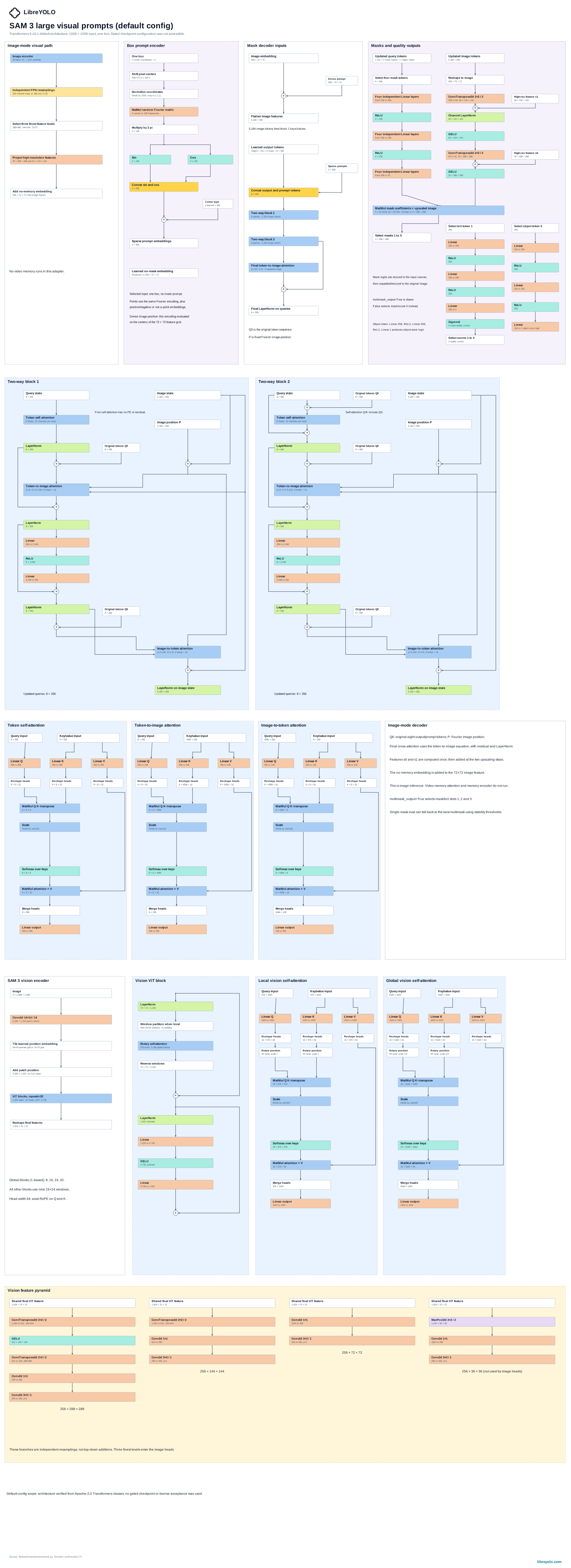
SAM 3
SAM 3 extends SAM with a text-concept prompt on top of the usual points and boxes, so a phrase like "yellow school bus" returns every matching instance. LibreYOLO supports its image path through a dedicated LibreSAM factory, separate from the LibreYOLO() detector factory.
- Tasks
- instance segmentation
- Sizes
- large at 1008 px
- Install
pip install libreyolo- Support tier
- Sibling tier, since v. A separate product surface with its own factory and contract.
- Licenses
- Code MIT, weights SAM License (Meta custom, gated). Commercial use
Install
SAM 3 needs the sam extra, which pulls in transformers and timm.
pip install "libreyolo[sam]"The weights are gated: visit
huggingface.co/facebook/sam3, accept
Meta's SAM License, then run hf auth login (or set HF_TOKEN) before the
first download. LibreYOLO logs a license notice the first time it downloads
this family.
Predict
LibreSAM(...) (or the family-specific LibreSAM3(...)) is a separate entry
point from LibreYOLO(...): it returns a promptable segmenter rather than a
detector, because a forward pass here is meaningless without a prompt. There
is no libreyolo predict CLI command for this family; use the Python API.
Only image inference is supported; SAM 3's video models are out of scope
here.
from libreyolo import LibreSAM, SAMPLE_IMAGE # "sam3" is the only size ("large"); aliases: "sam3", "sam-3", "sam3-large".model = LibreSAM("sam3") # A point prompt: [x, y] in pixel coordinates, label 1 = foreground.result = model.predict(SAMPLE_IMAGE, points=[640, 420], labels=[1])print(result.masks.xy) # polygon per maskprint(result.boxes.xyxy) # tight box derived from the mask # A box prompt instead of a point.result = model.predict(SAMPLE_IMAGE, bboxes=[300, 200, 900, 700])from libreyolo import LibreSAM3, SAMPLE_IMAGE model = LibreSAM3("large") # Finds every instance matching the phrase, not just one object.# text= is mutually exclusive with points, bboxes, labels and masks.result = model.predict(SAMPLE_IMAGE, text="a person")print(result.names) # {0: "a person"}print(result.boxes.conf) # the PCS detection score per instancefrom libreyolo import LibreSAM3, SAMPLE_IMAGE model = LibreSAM3("large") # The image encoder is the expensive part. set_image() runs it once;# every predict() call after that reuses the cached embedding. A# text= call re-encodes internally, since the tracker and the# concept-segmentation encoder do not share a cache.model.set_image(SAMPLE_IMAGE)a = model.predict(points=[640, 420], labels=[1])b = model.predict(bboxes=[300, 200, 900, 700])model.reset_image()The point and box path matches the rest of the SAM family: a point prompt
accepts [x, y] for one object or [[x, y], ...] for several, labels marks
each point 1 (foreground) or 0 (background), and a box prompt takes
[x1, y1, x2, y2] or a list of boxes. conf on this path filters by
predicted mask quality (IoU), not a detection confidence.
The text= path is SAM 3's addition: a concept string returns every matching
instance in the image through Promptable Concept Segmentation, and cannot be
combined with points, boxes, labels or masks. conf there is the PCS
detection score instead of mask IoU; leaving it at the default applies the
model's own 0.3 threshold, and conf=0.0 keeps every candidate. The returned
names maps class id 0 to the requested concept string, since a promptable
mask has no fixed class set otherwise. device= moves the model and, if a
set_image() session is active, its cached embedding. train(), val(),
export() and track() all raise NotImplementedError for this family: SAM
3 is predict-only in LibreYOLO, and video tracking is out of scope. See
prediction for source types.
Variants
One size, large, at a fixed 1008 px input. SAM 3.1 is not supported: its implementation carries a custom license that cannot be vendored into this MIT repository, and the Transformers version LibreYOLO depends on does not yet load its checkpoint format.
Licensing
Check the license on the Hugging Face repository of the specific weights you download. Every checkpoint in the LibreYOLO org carries one, and they are not always the same across a family. That repository is the authoritative source; the summary below describes what applied when this page was last verified.
This is a description of the licenses involved, not legal advice. If the answer matters commercially, read the licenses yourself and take your own counsel.
- Original work
- SAM 3, Meta FAIR
- Upstream license
- SAM License (Meta custom, gated)
- Upstream source
- github.com/facebookresearch/sam3
- LibreYOLO code
- MIT
- Weights
- SAM License (Meta custom, gated), distributed by their authors. LibreYOLO does not host or mirror them.
- Interpretation
- The SAM License is Meta's own agreement, not an OSI-approved license like MIT or Apache-2.0. It grants a worldwide, royalty-free license to use, reproduce, distribute and create derivative works, and does not itself say the weights are non-commercial. It does add terms Apache and MIT do not: publications that use the results must acknowledge SAM Materials, reverse engineering is prohibited, use is subject to export-control and sanctions compliance, filing IP litigation against Meta over the materials terminates your license, and Meta may amend the agreement. Weights are gated on facebook/sam3 on Hugging Face: you must accept the terms there and authenticate before downloading. LibreYOLO calls SAM 3 through the Apache-2.0 Transformers implementation and vendors none of Meta's model source, but does not redistribute the weights themselves; read the license yourself before relying on it commercially.
LibreYOLO does not host its own copy of the SAM 3 weights and does not
redistribute them. LibreSAM("sam3") downloads directly from Meta's gated
facebook/sam3 repository on Hugging Face, which requires accepting Meta's
SAM License and authenticating before the first download.
Citation
@misc{carion2025sam3segmentconcepts,
      title={SAM 3: Segment Anything with Concepts},
      author={Nicolas Carion and Laura Gustafson and Yuan-Ting Hu and Shoubhik Debnath and Ronghang Hu and Didac Suris and Chaitanya Ryali and Kalyan Vasudev Alwala and Haitham Khedr and Andrew Huang and Jie Lei and Tengyu Ma and Baishan Guo and Arpit Kalla and Markus Marks and Joseph Greer and Meng Wang and Peize Sun and Roman Rädle and Triantafyllos Afouras and Effrosyni Mavroudi and Katherine Xu and Tsung-Han Wu and Yu Zhou and Liliane Momeni and Rishi Hazra and Shuangrui Ding and Sagar Vaze and Francois Porcher and Feng Li and Siyuan Li and Aishwarya Kamath and Ho Kei Cheng and Piotr Dollár and Nikhila Ravi and Kate Saenko and Pengchuan Zhang and Christoph Feichtenhofer},
      year={2025},
      eprint={2511.16719},
      archivePrefix={arXiv},
      primaryClass={cs.CV},
      url={https://arxiv.org/abs/2511.16719},
}
Copied from the authors' citation block at github.com/facebookresearch/sam3#citing-sam-3.