TEED
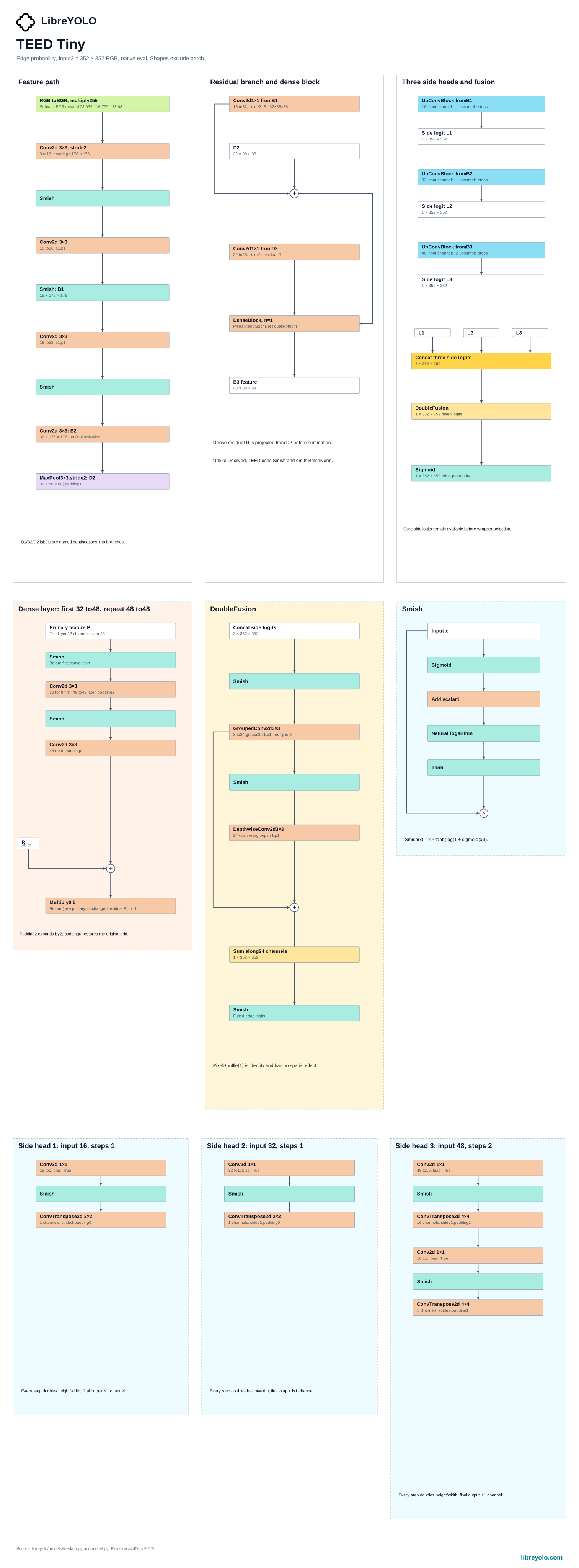
TEED (Tiny and Efficient Edge Detector) is a small convolutional network that predicts a dense edge-probability map from one RGB image. LibreYOLO wraps its architecture for edge detection only; no checkpoint ships with the library.
- Tasks
- edge
- Sizes
- t at 352 px
- Install
pip install libreyolo- Support tier
- Inference only, since v. Predict, validate and export only. Training features do not apply.
- Licenses
- Code MIT, weights MIT. Commercial use
Install
TEED needs no optional extra. Everything it imports is in the base install.
pip install libreyoloPredict
LibreYOLO ships no TEED checkpoint. The officially released weights are
trained on BIPED, whose published dataset terms restrict use to
non-commercial purposes, so LibreYOLO does not mirror them. Convert a
checkpoint you are licensed to use with weights/convert_teed_weights.py,
which checks the tensor keys against the runtime architecture before writing
a file LibreYOLO can load directly:
python weights/convert_teed_weights.py upstream.pth weights/LibreTEEDt-edge.pt --verifyfrom libreyolo import LibreYOLO, SAMPLE_IMAGE model = LibreYOLO("weights/LibreTEEDt-edge.pt")result = model(SAMPLE_IMAGE, save=True) edges = result.edgesprint(edges.array.shape) # (H, W) float32 in [0, 1]print(edges.binary(0.5).sum()) # thresholded edge-pixel countlibreyolo predict model=weights/LibreTEEDt-edge.pt source=https://raw.githubusercontent.com/LibreYOLO/libreyolo/release/libreyolo/assets/parkour.jpg save=Trueresult.edges holds the result: an (H, W) float32 array in [0, 1],
with .binary(threshold) returning a boolean edge mask. There are no boxes,
so conf, iou and max_det have no effect. See
prediction for sources, streaming and result handling.
Variants
TEED ships one size in LibreYOLO. LibreYOLO's benchmark harness has not measured this family, so there are no published numbers to compare it against.
Validate
val() reports BSDS-style ODS and OIS F-measures against a paired edge
dataset: images beside same-stem edge maps, with an optional validity mask so
padded pixels never count. imgsz must be divisible by the network's
downsample stride, and LibreYOLO raises a clear error if it is not.
from libreyolo import LibreYOLO model = LibreYOLO("weights/LibreTEEDt-edge.pt")metrics = model.val(data="my-dataset.yaml", imgsz=352) print(metrics["metrics/ODS"]) # optimal-dataset-scale F-measureprint(metrics["metrics/OIS"]) # optimal-image-scale F-measurelibreyolo val model=weights/LibreTEEDt-edge.pt data=my-dataset.yaml imgsz=352Export
| Task | ONNX | TorchScript | ExecuTorch | TensorRT | OpenVINO | Paddle | MNN | RKNN | ncnn | TFLite | CoreML | Core AI |
|---|---|---|---|---|---|---|---|---|---|---|---|---|
| edge | edge to ONNX: supported | edge to TorchScript: supported | edge to ExecuTorch: supported | edge to TensorRT: supported | edge to OpenVINO: supported | edge to Paddle: not supported | edge to MNN: not supported | edge to RKNN: not supported | edge to ncnn: not supported | edge to TFLite: supported | edge to CoreML: not supported | edge to Core AI: not supported |
Edge export uses a fixed-resolution, batch-1 runtime contract: dynamic and a
batch other than 1 are rejected, and the exported graph outputs a single
fused probability map. An exported artifact loads back through LibreYOLO()
on its file suffix, so a .onnx file behaves like a checkpoint and returns
the same Results.
from libreyolo import LibreYOLO model = LibreYOLO("weights/LibreTEEDt-edge.pt")model.export(format="onnx", imgsz=352)model.export(format="tensorrt", imgsz=352, half=True)libreyolo export model=weights/LibreTEEDt-edge.pt format=onnx imgsz=352libreyolo export model=weights/LibreTEEDt-edge.pt format=tensorrt imgsz=352 half=Truefrom libreyolo import LibreYOLO, SAMPLE_IMAGE model = LibreYOLO("weights/LibreTEEDt-edge.onnx")result = model(SAMPLE_IMAGE) print(result.edges.array.shape)Licensing
Check the license on the Hugging Face repository of the specific weights you download. Every checkpoint in the LibreYOLO org carries one, and they are not always the same across a family. That repository is the authoritative source; the summary below describes what applied when this page was last verified.
This is a description of the licenses involved, not legal advice. If the answer matters commercially, read the licenses yourself and take your own counsel.
- Original work
- TEED, Xavier Soria
- Upstream license
- MIT
- Upstream source
- github.com/xavysp/TEED
- LibreYOLO code
- MIT
- Weights
- MIT, distributed by their authors. LibreYOLO does not host or mirror them.
- Interpretation
- MIT is a permissive license, so the TEED architecture LibreYOLO ports can be used in commercial and closed-source products, with the license text and copyright notice kept alongside any copy you redistribute. LibreYOLO ships no checkpoint for this family: the officially released weights are trained on BIPED, whose published dataset terms restrict use to non-commercial purposes, and mirroring them would carry that restriction into a nominally MIT-licensed download. Convert a checkpoint you hold a license for with `weights/convert_teed_weights.py`; the MIT code license does not change the terms attached to whatever checkpoint you convert.
LibreYOLO publishes no TEED checkpoint. Nothing is mirrored under the
LibreYOLO organization; convert a checkpoint you hold a license for with
weights/convert_teed_weights.py instead.
Citation
@InProceedings{Soria_2023teed,
    author    = {Soria, Xavier and Li, Yachuan and Rouhani, Mohammad and Sappa, Angel D.},
    title     = {Tiny and Efficient Model for the Edge Detection Generalization},
    booktitle = {Proceedings of the IEEE/CVF International Conference on Computer Vision (ICCV) Workshops},
    month     = {October},
    year      = {2023},
    pages     = {1364-1373}
}
Copied from the authors' citation block at github.com/xavysp/TEED#citation.