Florence-2
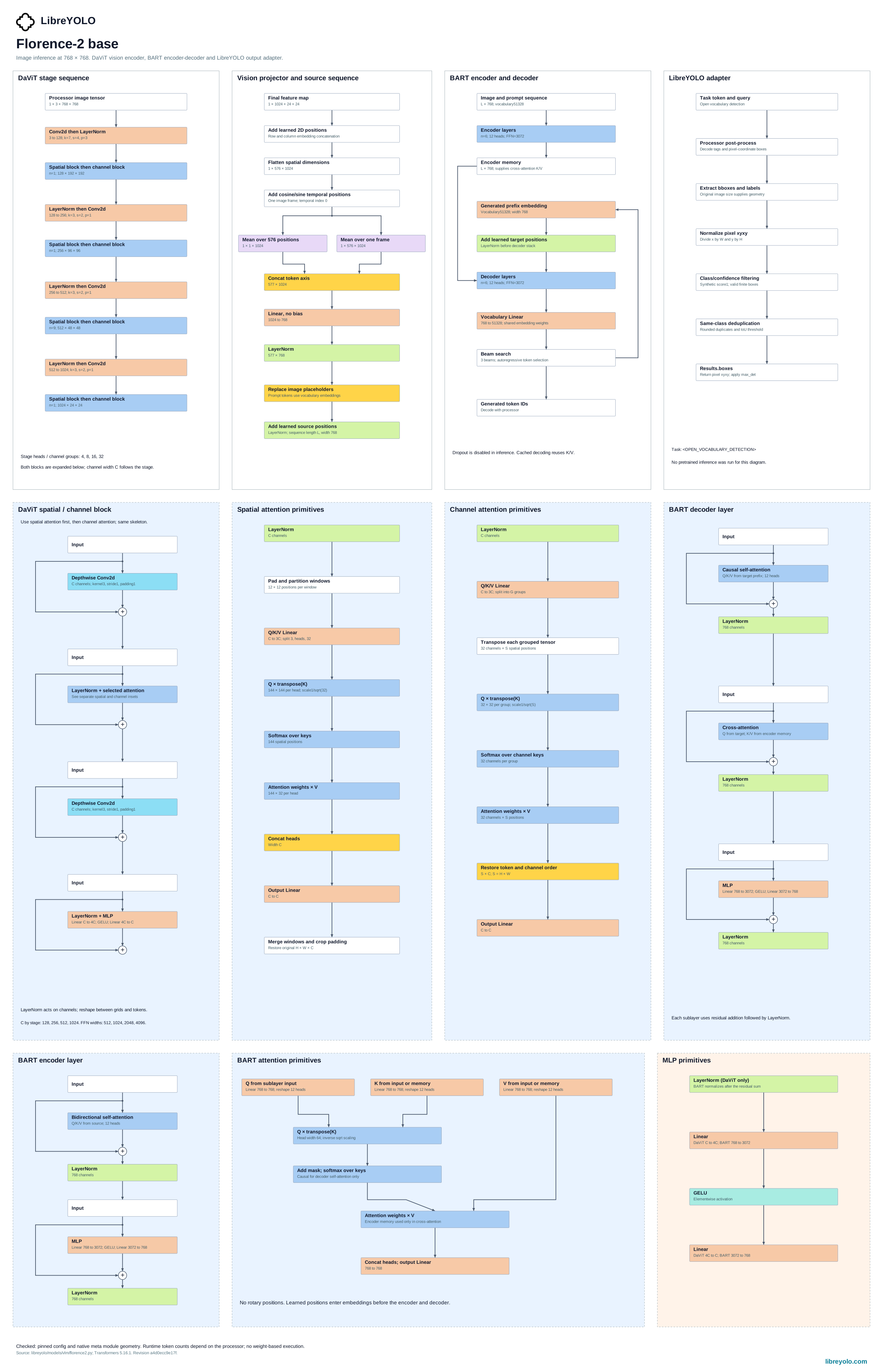
Florence-2 is Microsoft's vision foundation model, prompted with a task token instead of run through a fixed detection head. LibreYOLO wraps it as an open-vocabulary object detector: supply the class list at predict time.
- Tasks
- detection
- Sizes
- base, large at 768 px
- Install
pip install libreyolo- Support tier
- Sibling tier, since v. A separate product surface with its own factory and contract.
- Licenses
- Code MIT, weights MIT. Commercial use
Install
Florence-2 belongs to LibreYOLO's VLM-as-detector tier, a separate product
surface from the checkpoint-based families with its own factory. It needs the
vlm extra.
pip install "libreyolo[vlm]"Predict
Weights download from Hugging Face on first use and are cached locally.
LibreYOLO downloads the florence-community re-upload of the checkpoint rather
than the original microsoft/Florence-2-* repository; see Licensing for why.
from libreyolo import LibreVLM, SAMPLE_IMAGE model = LibreVLM("florence-2-base")model.set_classes(["car", "person", "traffic light"])result = model.predict(SAMPLE_IMAGE, save=True) for box in result.boxes: print(box.cls, box.conf, box.xyxy)from libreyolo import LibreVLM model = LibreVLM("florence-2-base")model.set_classes(["car", "person", "traffic light"]) # Any source the library accepts: file, folder, URL, webcam index,# RTSP stream, or a .streams listfor result in model.predict("clip.mp4", stream=True, save=True): print(len(result.boxes))This family loads through the LibreVLM() factory, not LibreYOLO(): VLM
families declare no checkpoint loader, so the file-suffix routing described on
other model pages does not apply here. set_classes() sets the vocabulary
Florence-2 is asked to find in the image; it is sticky, so it stays in effect
across every later predict()/track() call until you set it again. The
returned Results carries boxes in the same shape as any other family, but
every detection carries the same placeholder confidence, so conf filtering is
all-or-nothing rather than a ranking, and iou has no effect: Florence-2's
wrapper builds the detection list directly from the parsed task-token output,
with no deduplication step. chat() raises NotImplementedError here, because
Florence-2 is driven by the <OPEN_VOCABULARY_DETECTION> task token rather than
a chat template. LibreYOLO's CLI does not cover this tier: there is no
libreyolo predict model=... form for it. See prediction for
sources, streaming and result handling.
Variants
Two sizes: Florence-2-base and Florence-2-large, both at 768 px, loaded as
LibreVLM("florence-2-base") or LibreVLM("florence-2-large"). LibreYOLO has
not published a benchmark comparing accuracy between them.
LibreYOLO does not train, validate or export Florence-2: train(), val() and
export() all raise NotImplementedError for every family in this tier (see
the support tier above). Fine-tune Florence-2 upstream and load the resulting
weights if you need a custom vocabulary baked in; check predict() output by
eye instead of a COCO-style validation pass, since every detection carries the
same placeholder confidence.
Licensing
Check the license on the Hugging Face repository of the specific weights you download. Every checkpoint in the LibreYOLO org carries one, and they are not always the same across a family. That repository is the authoritative source; the summary below describes what applied when this page was last verified.
This is a description of the licenses involved, not legal advice. If the answer matters commercially, read the licenses yourself and take your own counsel.
- Original work
- Florence-2, Microsoft
- Upstream license
- MIT
- Upstream source
- huggingface.co/microsoft/Florence-2-large
- LibreYOLO code
- MIT
- Weights
- MIT, distributed by their authors. LibreYOLO does not host or mirror them.
- Interpretation
- MIT is a permissive license, so these weights can be used in commercial and closed-source products, provided the copyright notice and license text travel with any copy you redistribute. LibreYOLO downloads the florence-community re-upload of the checkpoint (florence-community/Florence-2-base and florence-community/Florence-2-large) rather than the original microsoft/Florence-2-* repositories, because those ship with custom remote code that no longer loads on current transformers releases. florence-community republishes the same weights through the native Florence2ForConditionalGeneration class, also under MIT, so nothing about the license changes.
Citation
@article{xiao2023florence,
  title={Florence-2: Advancing a unified representation for a variety of vision tasks},
  author={Xiao, Bin and Wu, Haiping and Xu, Weijian and Dai, Xiyang and Hu, Houdong and Lu, Yumao and Zeng, Michael and Liu, Ce and Yuan, Lu},
  journal={arXiv preprint arXiv:2311.06242},
  year={2023}
}
Copied from the authors' citation block at huggingface.co/microsoft/Florence-2-large#bibtex.