SSD
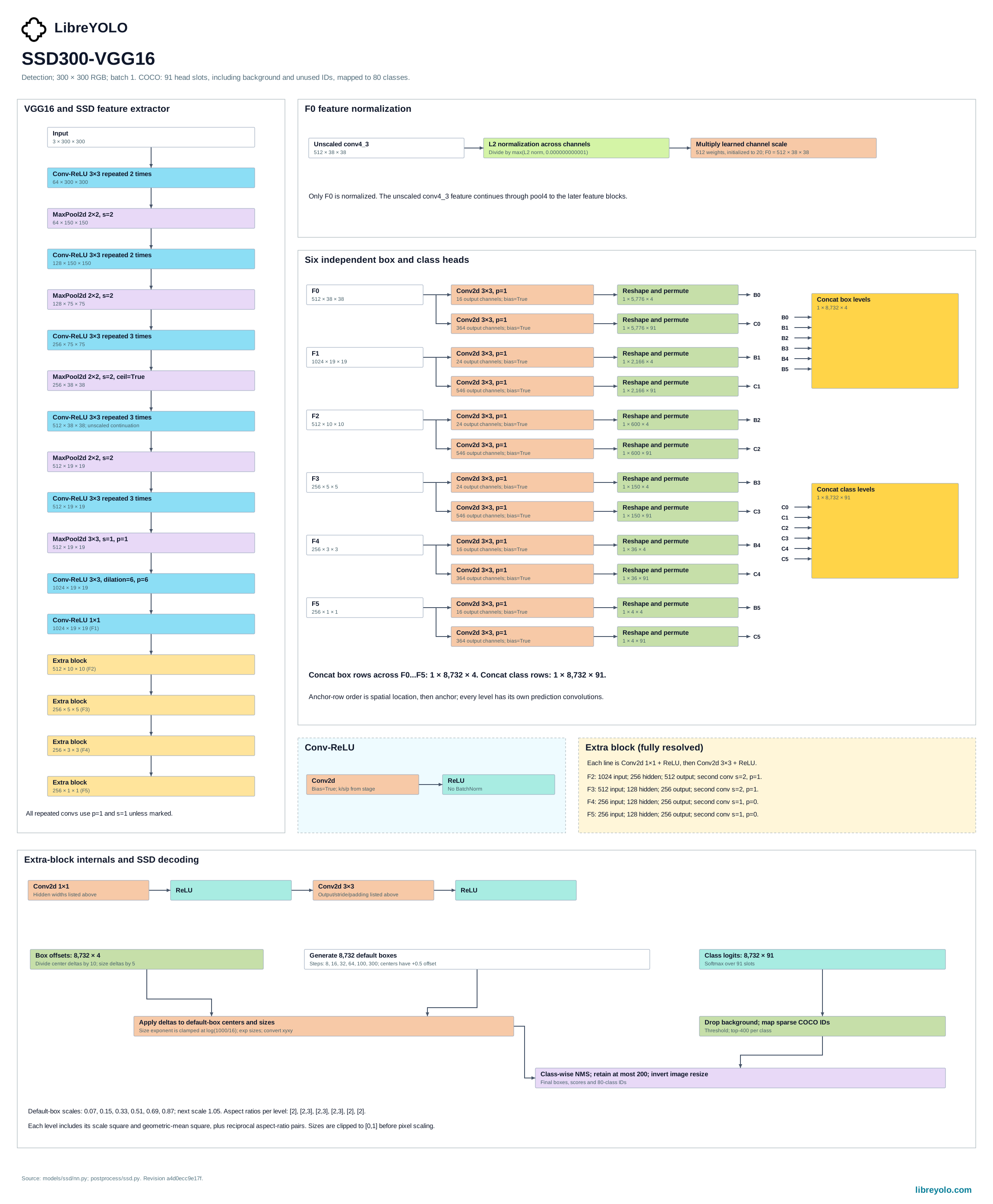
SSD (Single Shot MultiBox Detector) predicts every box and class score from a dense grid of default boxes in one forward pass, with no separate region-proposal stage. LibreYOLO ships the VGG16-backed SSD300 checkpoint as an inference-only detector.
- Tasks
- detection
- Sizes
- 300 at 300 px
- Install
pip install libreyolo- Support tier
- Inference only, since v. Predict, validate and export only. Training features do not apply.
- Upstream
- SSD by UNC Chapel Hill, Zoox, Google and University of Michigan, BSD-3-Clause. Paper, source
- Licenses
- Code BSD-3-Clause, weights BSD-3-Clause. Commercial use
Install
SSD needs no optional extra. Everything it imports is in the base install.
pip install libreyoloPredict
Weights download from Hugging Face on first use and are cached locally.
from libreyolo import LibreYOLO, SAMPLE_IMAGE model = LibreYOLO("LibreSSD300.pt")result = model(SAMPLE_IMAGE, save=True) for box in result.boxes: print(box.cls, box.conf, box.xyxy)libreyolo predict model=LibreSSD300.pt source=https://raw.githubusercontent.com/LibreYOLO/libreyolo/release/libreyolo/assets/parkour.jpg save=TrueThe returned Results object is the one every family returns, so swapping in a
different detector is a one line change. SSD decodes its default-box grid with
per-class scores and then runs non-maximum suppression, so conf, iou and
max_det all have a real effect here, unlike the query-based detectors in this
library. See prediction for sources, streaming and result
handling.
Variants
SSD ships one checkpoint: the VGG16-backed SSD300 network at its fixed native canvas. There is no size or scale choice in this family; predict, validate and export all use that one graph.
The weight file is LibreSSD300.pt, the family prefix followed by its only size
key, "300". The class behind it is LibreSSD, so a direct construction is
LibreSSD(size="300") rather than a class named after the file.
Validate
val() returns a dictionary of metrics/ keys covering precision, recall,
mAP 50 and mAP 50-95, measured against any dataset in the format you trained on.
from libreyolo import LibreYOLO model = LibreYOLO("LibreSSD300.pt")metrics = model.val(data="my-dataset.yaml") print(metrics["metrics/mAP50-95"])print(metrics["metrics/mAP50"])libreyolo val model=LibreSSD300.pt data=my-dataset.yamlExport
| Task | ONNX | TorchScript | ExecuTorch | TensorRT | OpenVINO | Paddle | MNN | RKNN | ncnn | TFLite | CoreML | Core AI |
|---|---|---|---|---|---|---|---|---|---|---|---|---|
| Detection | Detection to ONNX: supported | Detection to TorchScript: not supported | Detection to ExecuTorch: not supported | Detection to TensorRT: not supported | Detection to OpenVINO: not supported | Detection to Paddle: not supported | Detection to MNN: not supported | Detection to RKNN: not supported | Detection to ncnn: not supported | Detection to TFLite: not supported | Detection to CoreML: not supported | Detection to Core AI: not supported |
SSD exports to ONNX only; every other format is currently blocked for this
family. Export always uses the checkpoint's native canvas, and the graph
exposes SSD's raw packed head rather than a fused non-maximum-suppression
output, so nms=True is not accepted at export time. LibreYOLO's own backends
run the decode and suppression step after loading the graph back.
from libreyolo import LibreYOLO model = LibreYOLO("LibreSSD300.pt") # imgsz is left out here on purpose: SSD300 traces at its checkpoint's# native canvas, and any other value raises before export starts.model.export(format="onnx")libreyolo export model=LibreSSD300.pt format=onnxfrom libreyolo import LibreYOLO # The factory routes on the file suffix, so an exported artifact loads# like any checkpoint and returns the same Results object.model = LibreYOLO("LibreSSD300.onnx")result = model(SAMPLE_IMAGE) print(result.boxes.xyxy)Checkpoints
Every published weight file for this family.
| File | Input (px) | Weights license |
|---|---|---|
| Detection | ||
| LibreSSD300.pt | 300 | bsd-3-clause |
Every file above exists in the LibreYOLO org today and downloads on first use.
Licensing
Check the license on the Hugging Face repository of the specific weights you download. Every checkpoint in the LibreYOLO org carries one, and they are not always the same across a family. That repository is the authoritative source; the summary below describes what applied when this page was last verified.
This is a description of the licenses involved, not legal advice. If the answer matters commercially, read the licenses yourself and take your own counsel.
- Original work
- SSD, UNC Chapel Hill, Zoox, Google and University of Michigan
- Upstream license
- BSD-3-Clause
- Upstream source
- github.com/pytorch/vision
- LibreYOLO code
- MIT
- Weights
- BSD-3-Clause, republished at huggingface.co/LibreYOLO
- Interpretation
- BSD-3-Clause is a permissive license, so these weights can be used in commercial and closed-source products. It asks you to keep its copyright notice and disclaimer with any copy you redistribute, and it places no obligation on your own application code. The official SSD300 COCO checkpoint carries no separate, checkpoint-specific license: LibreYOLO's mirror applies BSD-3-Clause on an explicitly disclosed implied basis, the same basis torchvision states for its own pretrained SSD300 weights. The VGG16 backbone the graph is built on traces back to Oxford's fully convolutional reduced VGGNet, released under CC BY 4.0 by Karen Simonyan and Andrew Zisserman.
LibreYOLO's SSD300 code is not ported from the paper authors' own Caffe release; it derives from torchvision's BSD-3-Clause SSD300 implementation, and that is the repository linked above as the upstream source. The backbone's VGG16 weights trace further back to Oxford's fully convolutional reduced VGGNet, released under CC BY 4.0 by Karen Simonyan and Andrew Zisserman.
Citation
@inproceedings{liu2016ssd,
  title = {{SSD}: Single Shot MultiBox Detector},
  author = {Liu, Wei and Anguelov, Dragomir and Erhan, Dumitru and Szegedy, Christian and Reed, Scott and Fu, Cheng-Yang and Berg, Alexander C.},
  booktitle = {ECCV},
  year = {2016}
}
Copied from the authors' citation block at github.com/weiliu89/caffe/tree/ssd#citing-ssd.