DINOv2
DINOv2 is a self-supervised vision transformer trained by Meta AI to produce general-purpose image features without labels. LibreYOLO wraps its DINOv2-with-Registers backbone for three tasks: semantic segmentation, classification and whole-image embedding.
- Tasks
- semantic, classify, embed
- Sizes
- n, s, m, l at 518 px
- Install
pip install libreyolo- Support tier
- Supported, since v. Supporting trainables: kept green in CI, features land opportunistically.
- Licenses
- Code MIT, weights Apache-2.0. Commercial use
Install
LibreDINOv2 registers only when transformers is installed, the same
optional dependency RF-DETR needs for its DINOv2 backbone, so it needs the
same extra.
pip install "libreyolo[rfdetr]"Predict
LibreYOLO does not publish a LibreDINOv2 checkpoint. Construct the wrapper
directly instead of loading a file: model_path=None (the default) downloads
Meta's Apache-2.0 facebook/dinov2-with-registers-small backbone from Hugging
Face on first use. task= selects what runs on top of it.
from libreyolo import SAMPLE_IMAGEfrom libreyolo.models.dinov2.model import LibreDINOv2 # No LibreYOLO-hosted checkpoint exists for this family: this# downloads the Apache-2.0 DINOv2-with-Registers-small backbone from# Meta's Hugging Face org. The dense head starts at random# initialization until you train it (see Train below).model = LibreDINOv2(size="s", task="semantic", nb_classes=19)result = model(SAMPLE_IMAGE) mask = result.semantic_maskprint(mask.data.shape, mask.classes)from libreyolo import SAMPLE_IMAGEfrom libreyolo.models.dinov2.model import LibreDINOv2 # nb_classes= is your dataset's class count; the linear head starts# at random initialization until you train it.model = LibreDINOv2(size="s", task="classify", nb_classes=10)result = model(SAMPLE_IMAGE) print(result.probs.top1, result.probs.top1conf)from libreyolo import SAMPLE_IMAGEfrom libreyolo.models.dinov2.model import LibreDINOv2 # Bypasses every task head: the backbone alone is enough, so this# needs no fine-tuning to be useful.model = LibreDINOv2(size="s", task="embed")result = model(SAMPLE_IMAGE) print(result.embeddings.data.shape) # (1, D), L2-normalizedfrom libreyolo.models.dinov2.model import LibreDINOv2 model = LibreDINOv2(size="s", task="embed") # Convenience wrapper: runs predict() and stacks every row into one# (N, D) tensor.features = model.embed(["a.jpg", "b.jpg", "c.jpg"])print(features.shape)task="semantic" and task="classify" add a dense or linear head on top of
the backbone; that head is randomly initialized and only useful after you
train it (see Train). task="embed" skips every head and returns
the backbone's final normalized CLS token as one whole-image row in
result.embeddings, so it needs no training at all. result.boxes is
always None: none of the three tasks produce per-instance detections. See
prediction for sources, streaming and result handling.
Variants
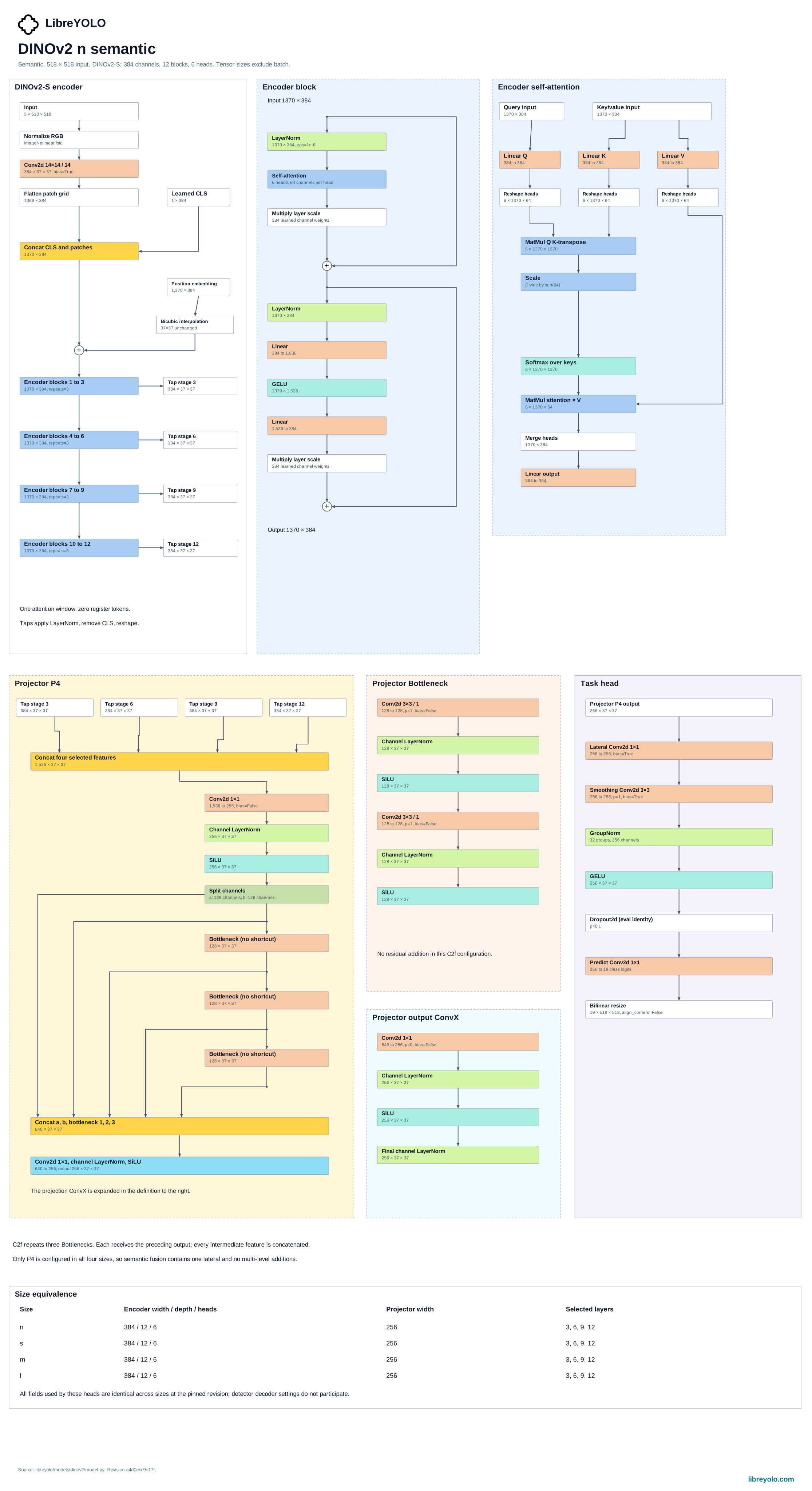
size selects the RF-DETR-style projector width layered on top of the
backbone, not the backbone itself: every size shares the same DINOv2-S
(small) encoder. Semantic segmentation runs at DINOv2's native square patch
grid; classification and embedding run at the smaller classification
resolution used to train the linear probe.
Train
task="semantic" and task="classify" both train; task="embed" has no
class-dependent head to fit and raises NotImplementedError if you call
train() on it.
from libreyolo.models.dinov2.model import LibreDINOv2 model = LibreDINOv2(size="s", task="semantic", nb_classes=19)model.train(data="my-dataset.yaml", epochs=100, batch_size=4, lr=1e-4)from libreyolo.models.dinov2.model import LibreDINOv2 model = LibreDINOv2(size="s", task="classify", nb_classes=10)model.train(data="my-dataset.yaml", epochs=100, batch_size=4, lr=1e-4)from libreyolo.models.dinov2.model import LibreDINOv2 model = LibreDINOv2(size="s", task="semantic", nb_classes=19)model.train( data="my-dataset.yaml", epochs=100, batch_size=4, lr=1e-4, device="0,1",)The primary keyword arguments here are batch_size and lr, not batch and
lr0 used by most other families; batch and lr0 are still accepted and
mapped onto them, but passing both raises a conflict error. output_dir=
(default "runs/train") replaces project=/name= as the primary way to
place a run, though passing project=/name= directly still works. See
training for datasets, augmentation, multi-GPU and loggers.
Validate
val() returns a dictionary of metrics/ keys: mIoU and pixel accuracy for
task="semantic", top-1 and top-5 accuracy for task="classify".
task="embed" has no ground truth to score against and raises
NotImplementedError if you call val() on it.
from libreyolo.models.dinov2.model import LibreDINOv2 model = LibreDINOv2(size="s", task="semantic", nb_classes=19)metrics = model.val(data="my-dataset.yaml") print(metrics["metrics/mIoU"])print(metrics["metrics/pixel_accuracy"])from libreyolo.models.dinov2.model import LibreDINOv2 model = LibreDINOv2(size="s", task="classify", nb_classes=10)metrics = model.val(data="my-dataset.yaml") print(metrics["metrics/accuracy_top1"])print(metrics["metrics/accuracy_top5"])Export
| Task | ONNX | TorchScript | ExecuTorch | TensorRT | OpenVINO | Paddle | MNN | RKNN | ncnn | TFLite | CoreML | Core AI |
|---|---|---|---|---|---|---|---|---|---|---|---|---|
| semantic | semantic to ONNX: supported | semantic to TorchScript: supported | semantic to ExecuTorch: supported | semantic to TensorRT: supported | semantic to OpenVINO: supported | semantic to Paddle: not supported | semantic to MNN: not supported | semantic to RKNN: not supported | semantic to ncnn: not supported | semantic to TFLite: not supported | semantic to CoreML: not supported | semantic to Core AI: not supported |
| classify | classify to ONNX: supported | classify to TorchScript: supported | classify to ExecuTorch: supported | classify to TensorRT: supported | classify to OpenVINO: supported | classify to Paddle: not supported | classify to MNN: not supported | classify to RKNN: not supported | classify to ncnn: not supported | classify to TFLite: not supported | classify to CoreML: not supported | classify to Core AI: supported |
| embed | embed to ONNX: supported | embed to TorchScript: supported | embed to ExecuTorch: supported | embed to TensorRT: supported | embed to OpenVINO: supported | embed to Paddle: not supported | embed to MNN: not supported | embed to RKNN: not supported | embed to ncnn: not supported | embed to TFLite: supported | embed to CoreML: not supported | embed to Core AI: not supported |
Each task supports a different subset of formats, shown above. An exported
artifact loads back through LibreYOLO() on its file suffix, so a .onnx or
.engine file behaves like a checkpoint and returns the same Results.
Export lists the arguments every format accepts.
from libreyolo.models.dinov2.model import LibreDINOv2 model = LibreDINOv2(size="s", task="semantic", nb_classes=19)model.export(format="onnx")from libreyolo.models.dinov2.model import LibreDINOv2 model = LibreDINOv2(size="s", task="classify", nb_classes=10)model.export(format="onnx")from libreyolo.models.dinov2.model import LibreDINOv2 model = LibreDINOv2(size="s", task="embed")model.export(format="tflite")from libreyolo import LibreYOLO, SAMPLE_IMAGE # The factory routes on the file suffix, so an exported artifact loads# like any checkpoint and returns the same Results object. Export# names the file from the task, here LibreDINOv2s-sem.onnx.model = LibreYOLO("LibreDINOv2s-sem.onnx")result = model(SAMPLE_IMAGE)Licensing
Check the license on the Hugging Face repository of the specific weights you download. Every checkpoint in the LibreYOLO org carries one, and they are not always the same across a family. That repository is the authoritative source; the summary below describes what applied when this page was last verified.
This is a description of the licenses involved, not legal advice. If the answer matters commercially, read the licenses yourself and take your own counsel.
- Original work
- DINOv2, Meta AI (FAIR)
- Upstream license
- Apache-2.0
- Upstream source
- github.com/facebookresearch/dinov2
- LibreYOLO code
- MIT
- Weights
- Apache-2.0, distributed by their authors. LibreYOLO does not host or mirror them.
- Interpretation
- Apache-2.0 is a permissive license, so these weights can be used in commercial and closed-source products. It asks you to keep its license text and attribution notices with any copy of the weights you redistribute, and it grants a patent license. LibreYOLO does not host or republish a DINOv2 checkpoint of its own: LibreDINOv2 downloads the pretrained backbone directly from Meta's facebook/dinov2-with-registers-small repository on Hugging Face the first time it runs, unmodified. The semantic and classification heads start at random initialization until you train them, since LibreYOLO does not publish a trained head for this family.
The "Weights" row above names the license that applies, Apache-2.0, but
nothing is actually republished under the LibreYOLO Hugging Face org for this
family: LibreYOLO hosts no LibreDINOv2 checkpoint of its own. What
LibreDINOv2(model_path=None) downloads is Meta's own
facebook/dinov2-with-registers-small repository, untouched.
Citation
@misc{oquab2023dinov2,
  title={DINOv2: Learning Robust Visual Features without Supervision},
  author={Oquab, Maxime and Darcet, Timothée and Moutakanni, Theo and Vo, Huy V. and Szafraniec, Marc and Khalidov, Vasil and Fernandez, Pierre and Haziza, Daniel and Massa, Francisco and El-Nouby, Alaaeldin and Howes, Russell and Huang, Po-Yao and Xu, Hu and Sharma, Vasu and Li, Shang-Wen and Galuba, Wojciech and Rabbat, Mike and Assran, Mido and Ballas, Nicolas and Synnaeve, Gabriel and Misra, Ishan and Jegou, Herve and Mairal, Julien and Labatut, Patrick and Joulin, Armand and Bojanowski, Piotr},
  journal={arXiv:2304.07193},
  year={2023}
}
Copied from the authors' citation block at github.com/facebookresearch/dinov2#citing-dinov2.