Grounding DINO
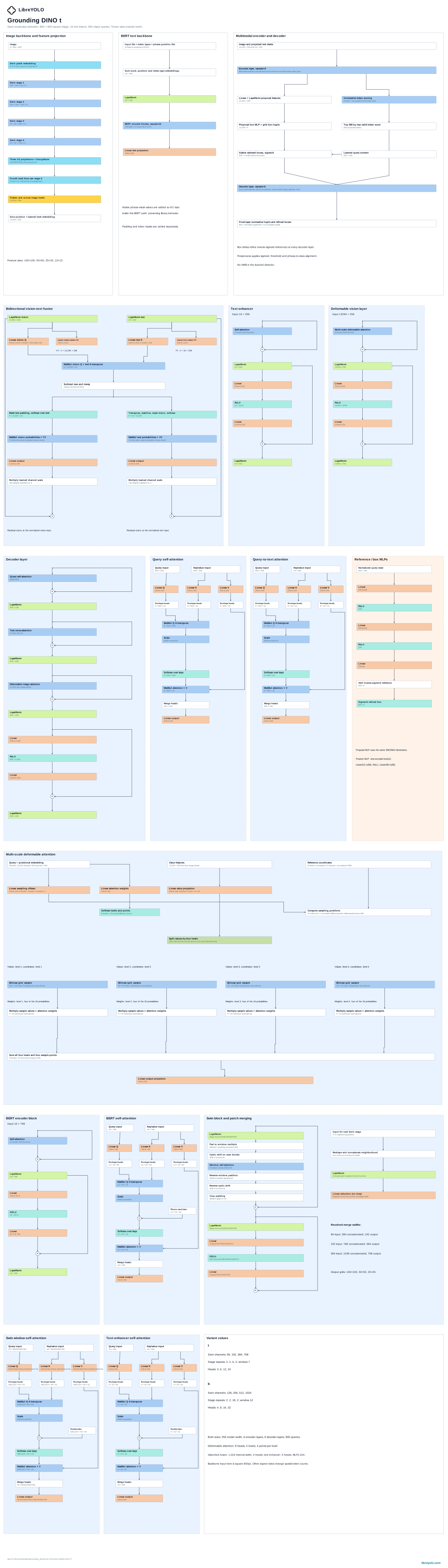
Grounding DINO is an open-set object detector, developed by IDEA Research, that scores an image against a free-text prompt instead of a fixed class list. LibreYOLO wraps it as a predict-only family in its open-vocabulary detector tier.
- Tasks
- detection
- Sizes
- t, b at 800 px
- Install
pip install libreyolo- Support tier
- Sibling tier, since v. A separate product surface with its own factory and contract.
- Licenses
- Code MIT, weights Apache-2.0. Commercial use
Install
Grounding DINO loads through LibreYOLO's open-vocabulary detector tier, which
needs the openvocab extra:
pip install "libreyolo[openvocab]"That extra pulls in transformers and timm, the Hugging Face libraries this
tier calls into.
Predict
Grounding DINO is not a checkpoint LibreYOLO loads through LibreYOLO(). It
loads through the sibling LibreOpenVocab factory, which downloads a Hugging
Face snapshot on first use and caches it under weights/.
from libreyolo import LibreOpenVocab, SAMPLE_IMAGE model = LibreOpenVocab("grounding-dino-t")model.set_classes(["person", "dog", "skateboard"]) result = model.predict(SAMPLE_IMAGE, conf=0.25)for box in result.boxes: print(box.cls, box.conf, box.xyxy)from libreyolo import LibreOpenVocab, SAMPLE_IMAGE model = LibreOpenVocab("grounding-dino-b")model.set_classes(["remote control", "school bus"]) # conf filters by box score, text_threshold by the decoded phrase's# token score. Both default to 0.25 when left unset.result = model.predict(SAMPLE_IMAGE, conf=0.25, text_threshold=0.3)print(result.names)set_classes() sets a sticky text vocabulary: call it again to replace the
list, or skip it to keep the default COCO-80 labels. Grounding DINO decodes
free-form phrases from its own text output and maps them back to that
vocabulary itself, an exact normalized match wins, a whole-token match is
accepted, and an ambiguous or unmatched phrase is dropped rather than guessed
at, so school bus never gets mapped to bus or school alone. A vocabulary
long enough to exceed the text encoder's token limit is split into several
prompts, run as separate forward passes, and merged back into one set of
detections capped by max_det.
iou is accepted for API compatibility but warns and does nothing, since
nothing here runs non-maximum suppression. imgsz and augment=True are
rejected outright: the transformers processor owns resizing, and test-time
augmentation is out of scope for this tier. predict() on a single image
returns one Results, not a list; pass a directory, a list of images, or
stream=True for a video source to get several. There is no CLI path for this
family, libreyolo predict only loads .pt checkpoints through
LibreYOLO(), so LibreOpenVocab families run from Python. See
prediction for source types and streaming.
Variants
Two checkpoints, t and b. t is this tier's default size when none is
given. Both mirror the official IDEA Research release through transformers'
GroundingDinoForObjectDetection, downloaded once into a LibreYOLO-hosted
Hugging Face snapshot that preserves the upstream files. No accuracy or
latency numbers are published for this family yet.
Training, dataset validation and export are all out of scope for this tier:
train(), val() and export() all raise NotImplementedError
unconditionally. This is a predict-only wrapper around a published checkpoint.
Checkpoints
Every published weight file for this family.
| File | Input (px) | Weights license |
|---|---|---|
| Detection | ||
| LibreGroundingDINOt.pt | 800 | apache-2.0 |
| LibreGroundingDINOb.pt | 800 | apache-2.0 |
Every file above exists in the LibreYOLO org today and downloads on first use.
Licensing
Check the license on the Hugging Face repository of the specific weights you download. Every checkpoint in the LibreYOLO org carries one, and they are not always the same across a family. That repository is the authoritative source; the summary below describes what applied when this page was last verified.
This is a description of the licenses involved, not legal advice. If the answer matters commercially, read the licenses yourself and take your own counsel.
- Original work
- Grounding DINO, IDEA Research
- Upstream license
- Apache-2.0
- Upstream source
- github.com/IDEA-Research/GroundingDINO
- LibreYOLO code
- MIT
- Weights
- Apache-2.0, republished at huggingface.co/LibreYOLO
- Interpretation
- Apache-2.0 is a permissive license, so this checkpoint can be used in commercial and closed-source products. It asks you to keep the license text and attribution notices with any copy of the weights you redistribute, and it grants a patent license. LibreYOLO vendors no Grounding DINO model source of its own: LibreGroundingDINO calls the Apache-2.0 `transformers` implementation, `GroundingDinoForObjectDetection`, directly, and downloads the official checkpoint into a LibreYOLO-hosted mirror repository that preserves the upstream snapshot files.
Citation
@article{liu2023grounding,
  title={Grounding dino: Marrying dino with grounded pre-training for open-set object detection},
  author={Liu, Shilong and Zeng, Zhaoyang and Ren, Tianhe and Li, Feng and Zhang, Hao and Yang, Jie and Li, Chunyuan and Yang, Jianwei and Su, Hang and Zhu, Jun and others},
  journal={arXiv preprint arXiv:2303.05499},
  year={2023}
}
Copied from the authors' citation block at github.com/IDEA-Research/GroundingDINO#black_nib-citation.