Depth Anything V2
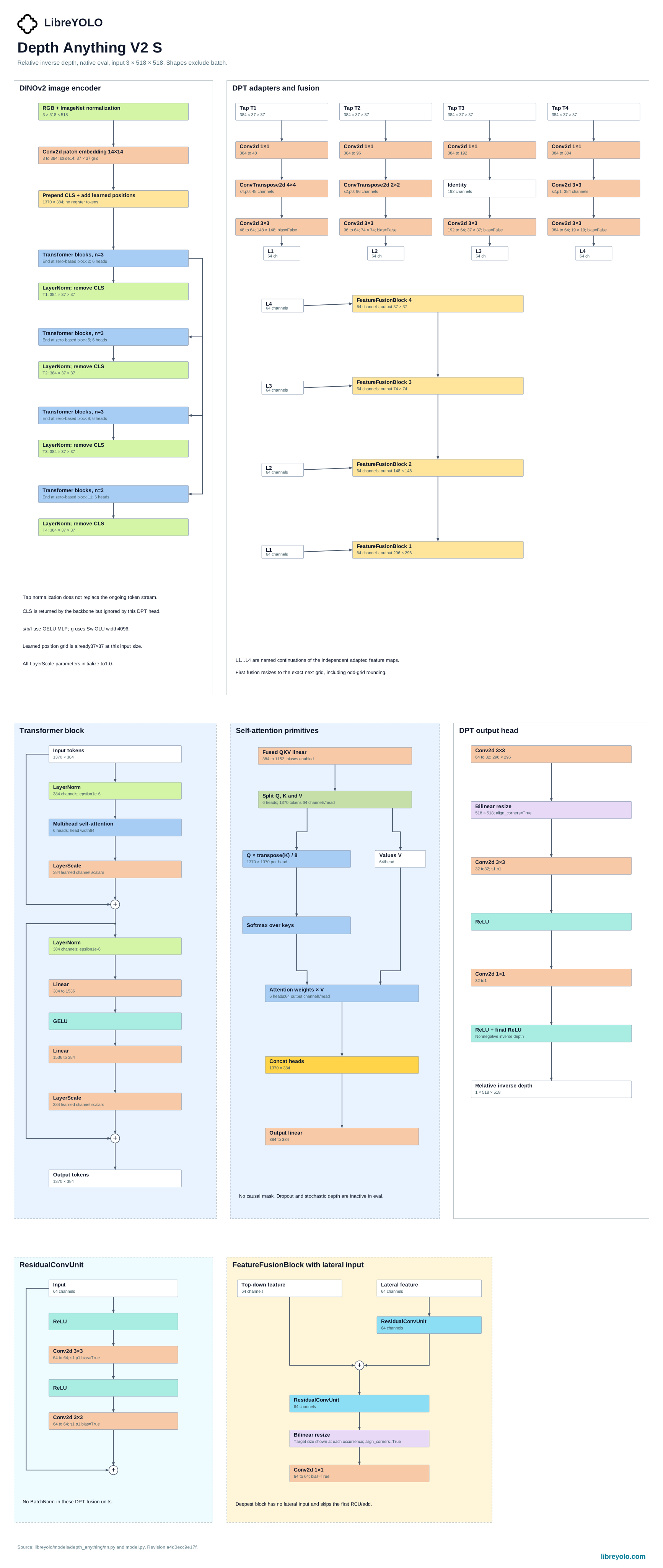
Depth Anything V2 is a DINOv2 encoder paired with a DPT decoder that predicts a dense relative inverse-depth map from a single image. LibreYOLO supports it for the depth task: predict and zero-shot validation, with no training path.
- Tasks
- depth
- Sizes
- s, b, l, g at 518 px
- Install
pip install libreyolo- Support tier
- Inference only, since v. Predict, validate and export only. Training features do not apply.
- Upstream
- Depth Anything V2 by The University of Hong Kong and TikTok, Apache-2.0 (Small checkpoint); CC-BY-NC-4.0 (Base and Large checkpoints). Paper, source
- Licenses
- Code Apache-2.0, weights Apache-2.0 (Small checkpoint); CC-BY-NC-4.0 (Base and Large checkpoints). Commercial use
Install
Depth Anything V2 needs no optional extra. Everything it imports is in the base install.
pip install libreyoloPredict
Weights download from Hugging Face on first use and are cached locally.
from libreyolo import LibreYOLO, SAMPLE_IMAGE model = LibreYOLO("LibreDepthAnythingV2s-depth.pt")result = model(SAMPLE_IMAGE, save=True) depth = result.depth_mapprint(depth.min, depth.max, depth.mean)libreyolo predict model=LibreDepthAnythingV2s-depth.pt source=https://raw.githubusercontent.com/LibreYOLO/libreyolo/release/libreyolo/assets/parkour.jpg save=Truefrom libreyolo import LibreYOLO, SAMPLE_IMAGE model = LibreYOLO("LibreDepthAnythingV2s-depth.pt")result = model(SAMPLE_IMAGE) depth = result.depth_map # DepthMap: dense (H, W), higher = closerraw = depth.data # tensor, no metric unit or cross-image scalenormalized = depth.normalized() # rescaled to [0, 1] for visualizationresult.depth_map carries a dense relative inverse-depth map: higher values
mean closer to the camera, and the values have no metric unit or cross-image
scale. save=True writes a colormapped visualization of that map to disk;
Results.plot() does not cover this family, since it is defined for surface
normals and edges only. Input resolution must divide evenly by 14, the DINOv2
patch grid the DPT head builds on; LibreYOLO checks this before running and
raises if it does not. See prediction for sources, streaming
and result handling.
Variants
Four encoder sizes, s/b/l/g, corresponding to ViT-S/B/L/G. The checkpoint table below lists only s, b and l; no Giant checkpoint is published. All four share the same input resolution, so choosing a size trades encoder capacity, not image size. Licensing is also a factor: the Small checkpoint is Apache-2.0, while Base and Large are CC-BY-NC-4.0, see Licensing below.
Training and fine-tuning are not offered for this family. LibreDepthAnythingV2.train()
raises NotImplementedError unconditionally; convert a compatible upstream
checkpoint instead, with weights/convert_depth_anything_v2_weights.py.
Validate
val() runs the shared depth validator: it aligns each prediction to its
ground truth with a per-image least-squares scale and shift, then reports the
standard zero-shot relative-depth metrics, AbsRel, RMSE and the three delta
thresholds.
from libreyolo import LibreYOLO model = LibreYOLO("LibreDepthAnythingV2s-depth.pt")metrics = model.val(data="my-dataset.yaml") print(metrics["metrics/abs_rel"])print(metrics["metrics/rmse"])print(metrics["metrics/delta1"])libreyolo val model=LibreDepthAnythingV2s-depth.pt data=my-dataset.yamlExport
| Task | ONNX | TorchScript | ExecuTorch | TensorRT | OpenVINO | Paddle | MNN | RKNN | ncnn | TFLite | CoreML | Core AI |
|---|---|---|---|---|---|---|---|---|---|---|---|---|
| depth | depth to ONNX: supported | depth to TorchScript: supported | depth to ExecuTorch: supported | depth to TensorRT: supported | depth to OpenVINO: supported | depth to Paddle: not supported | depth to MNN: not supported | depth to RKNN: not supported | depth to ncnn: not supported | depth to TFLite: not supported | depth to CoreML: not supported | depth to Core AI: supported |
An exported artifact loads back through LibreYOLO() on its file suffix, so a
.onnx or .engine file behaves like a checkpoint and returns the same
Results, with depth_map in place of boxes. Export lists the
arguments every format accepts.
from libreyolo import LibreYOLO model = LibreYOLO("LibreDepthAnythingV2s-depth.pt")model.export(format="onnx")model.export(format="tensorrt", half=True)libreyolo export model=LibreDepthAnythingV2s-depth.pt format=onnxlibreyolo export model=LibreDepthAnythingV2s-depth.pt format=tensorrt half=Truefrom libreyolo import LibreYOLO, SAMPLE_IMAGE # The factory routes on the file suffix, so an exported artifact loads# like any checkpoint and returns the same Results object.model = LibreYOLO("LibreDepthAnythingV2s-depth.onnx")result = model(SAMPLE_IMAGE) print(result.depth_map.data.shape)Checkpoints
Every published weight file for this family.
| File | Input (px) | Weights license |
|---|---|---|
| depth | ||
| LibreDepthAnythingV2s-depth.pt | apache-2.0 | |
| LibreDepthAnythingV2l-depth.pt | cc-by-nc-4.0 | |
| LibreDepthAnythingV2b-depth.pt | cc-by-nc-4.0 | |
Every file above exists in the LibreYOLO org today and downloads on first use.
Licensing
Check the license on the Hugging Face repository of the specific weights you download. Every checkpoint in the LibreYOLO org carries one, and they are not always the same across a family. That repository is the authoritative source; the summary below describes what applied when this page was last verified.
This is a description of the licenses involved, not legal advice. If the answer matters commercially, read the licenses yourself and take your own counsel.
- Original work
- Depth Anything V2, The University of Hong Kong and TikTok
- Upstream license
- Apache-2.0 (Small checkpoint); CC-BY-NC-4.0 (Base and Large checkpoints)
- Upstream source
- github.com/DepthAnything/Depth-Anything-V2
- LibreYOLO code
- MIT
- Weights
- Apache-2.0 (Small checkpoint); CC-BY-NC-4.0 (Base and Large checkpoints), republished at huggingface.co/LibreYOLO
- Interpretation
- The two licenses are not interchangeable. The Small checkpoint is Apache-2.0, a permissive license: it can be used in commercial and closed-source products, it asks you to keep its license text and attribution notices with any redistributed copy, and it grants a patent license. The Base and Large checkpoints are CC-BY-NC-4.0, which forbids commercial use outright and requires attribution on any redistribution, so treat them as research and evaluation weights unless you obtain separate terms from the authors. LibreYOLO's own code for this family is MIT throughout, and training is not offered for this family so there is no self-trained-weights exception to reach for.
Citation
@article{depth_anything_v2,
  title={Depth Anything V2},
  author={Yang, Lihe and Kang, Bingyi and Huang, Zilong and Zhao, Zhen and Xu, Xiaogang and Feng, Jiashi and Zhao, Hengshuang},
  journal={arXiv:2406.09414},
  year={2024}
}
Copied from the authors' citation block at github.com/DepthAnything/Depth-Anything-V2#citation.