DeepLabv3
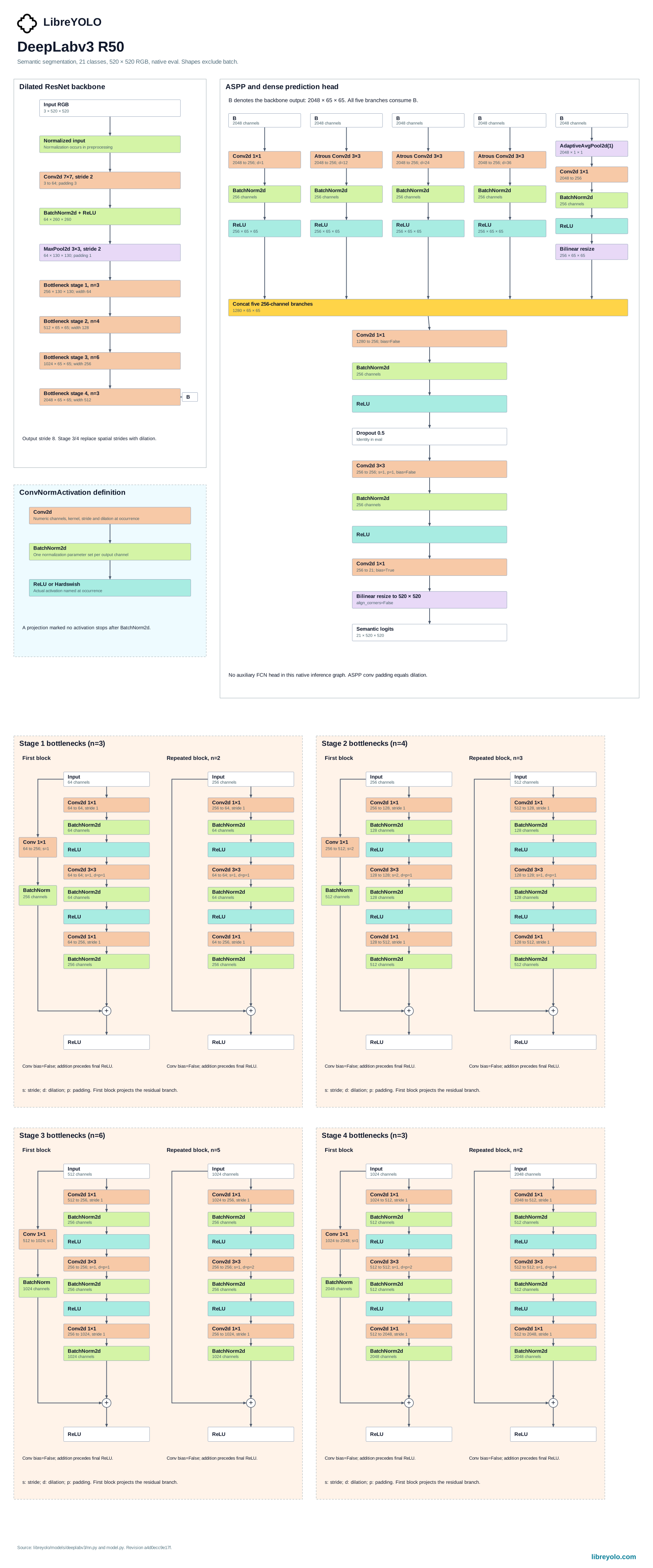
A semantic segmentation network that pools features at several dilation rates in parallel (atrous spatial pyramid pooling) before classifying each pixel. LibreYOLO ships it for semantic segmentation only.
- Tasks
- semantic
- Sizes
- Install
pip install libreyolo- Support tier
- Inference only, since v. Predict, validate and export only. Training features do not apply.
- Licenses
- Code BSD-3-Clause, weights BSD-3-Clause. Commercial use
Install
DeepLabv3 needs no optional extra. Everything it imports is in the base install.
pip install libreyoloPredict
Weights download from Hugging Face on first use and are cached locally. The
-sem filename suffix is required for this family.
from libreyolo import LibreYOLO, SAMPLE_IMAGE model = LibreYOLO("LibreDeepLabv3r50-sem.pt")result = model(SAMPLE_IMAGE, save=True) mask = result.semantic_maskprint(mask.data.shape) # (H, W) class idsprint(mask.classes) # sorted class ids present in the imagelibreyolo predict model=LibreDeepLabv3r50-sem.pt source=https://raw.githubusercontent.com/LibreYOLO/libreyolo/release/libreyolo/assets/parkour.jpg save=TrueSemantic segmentation returns one class id per pixel, not boxes, so
result.semantic_mask carries a (H, W) array on .data and the list of
class ids present in the image on .classes. conf, iou and max_det are
accepted for API parity but have no effect: the model assigns a class to every
pixel by argmax, with no confidence threshold or NMS step. See
prediction for sources, streaming and result handling.
Variants
Three backbones: dilated ResNet-50, dilated ResNet-101, and dilated MobileNetV3-Large. This is DeepLabv3, not DeepLabv3+, so there is no decoder stage or CRF refinement, matching torchvision's implementation rather than the paper's own reference code.
LibreYOLO does not train DeepLabv3: train() raises NotImplementedError for
this family, which the support tier above marks as inference
only. The three published checkpoints are torchvision's own COCO-with-VOC-label
weights, converted for LibreYOLO's loader.
Validate
val() returns metrics/mIoU and metrics/pixel_accuracy, measured against
any dataset in the format you trained on.
from libreyolo import LibreYOLO model = LibreYOLO("LibreDeepLabv3r50-sem.pt")metrics = model.val(data="my-dataset.yaml") print(metrics["metrics/mIoU"])print(metrics["metrics/pixel_accuracy"])libreyolo val model=LibreDeepLabv3r50-sem.pt data=my-dataset.yamlExport
| Task | ONNX | TorchScript | ExecuTorch | TensorRT | OpenVINO | Paddle | MNN | RKNN | ncnn | TFLite | CoreML | Core AI |
|---|---|---|---|---|---|---|---|---|---|---|---|---|
| semantic | semantic to ONNX: supported | semantic to TorchScript: supported | semantic to ExecuTorch: not supported | semantic to TensorRT: supported | semantic to OpenVINO: supported | semantic to Paddle: not supported | semantic to MNN: not supported | semantic to RKNN: not supported | semantic to ncnn: not supported | semantic to TFLite: not supported | semantic to CoreML: not supported | semantic to Core AI: not supported |
An exported artifact loads back through LibreYOLO() on its file suffix, so a
.onnx or .engine file behaves like a checkpoint and returns the same
Results. Export lists the arguments every format accepts.
from libreyolo import LibreYOLO model = LibreYOLO("LibreDeepLabv3r50-sem.pt")model.export(format="onnx")model.export(format="tensorrt", half=True)libreyolo export model=LibreDeepLabv3r50-sem.pt format=onnxlibreyolo export model=LibreDeepLabv3r50-sem.pt format=tensorrt half=Truefrom libreyolo import LibreYOLO, SAMPLE_IMAGE # The factory routes on the file suffix, so an exported artifact loads# like any checkpoint and returns the same Results object.model = LibreYOLO("LibreDeepLabv3r50-sem.onnx")result = model(SAMPLE_IMAGE) print(result.semantic_mask.data.shape)Checkpoints
Every published weight file for this family.
| File | Input (px) | Weights license |
|---|---|---|
| semantic | ||
| LibreDeepLabv3r50-sem.pt | bsd-3-clause | |
| LibreDeepLabv3r101-sem.pt | bsd-3-clause | |
| LibreDeepLabv3mv3-sem.pt | bsd-3-clause | |
Every file above exists in the LibreYOLO org today and downloads on first use.
Licensing
Check the license on the Hugging Face repository of the specific weights you download. Every checkpoint in the LibreYOLO org carries one, and they are not always the same across a family. That repository is the authoritative source; the summary below describes what applied when this page was last verified.
This is a description of the licenses involved, not legal advice. If the answer matters commercially, read the licenses yourself and take your own counsel.
- Original work
- DeepLabv3, PyTorch
- Upstream license
- BSD-3-Clause
- Upstream source
- github.com/pytorch/vision
- LibreYOLO code
- MIT
- Weights
- BSD-3-Clause, republished at huggingface.co/LibreYOLO
- Interpretation
- BSD-3-Clause is a permissive license, so this code and these weights can be used in commercial and closed-source products. It asks you to keep the copyright notice, license text and a non-endorsement clause with any copy you redistribute. LibreYOLO's inference graph is torchvision's ASPP head over its ResNet-50, ResNet-101 and MobileNetV3-Large backbones; it is DeepLabv3, not DeepLabv3+, so there is no decoder or CRF, and the paper's training-only auxiliary FCN classifier is excluded. The three published checkpoints are torchvision's official COCO-with-VOC-label weights; their separate LibreYOLO Hugging Face mirrors carry BSD-3-Clause on an implied basis disclosed by torchvision rather than an explicit checkpoint-specific grant, and torchvision's own documentation notes that pretrained-model terms can depend on the training data, leaving that determination to the user.