RTMDet
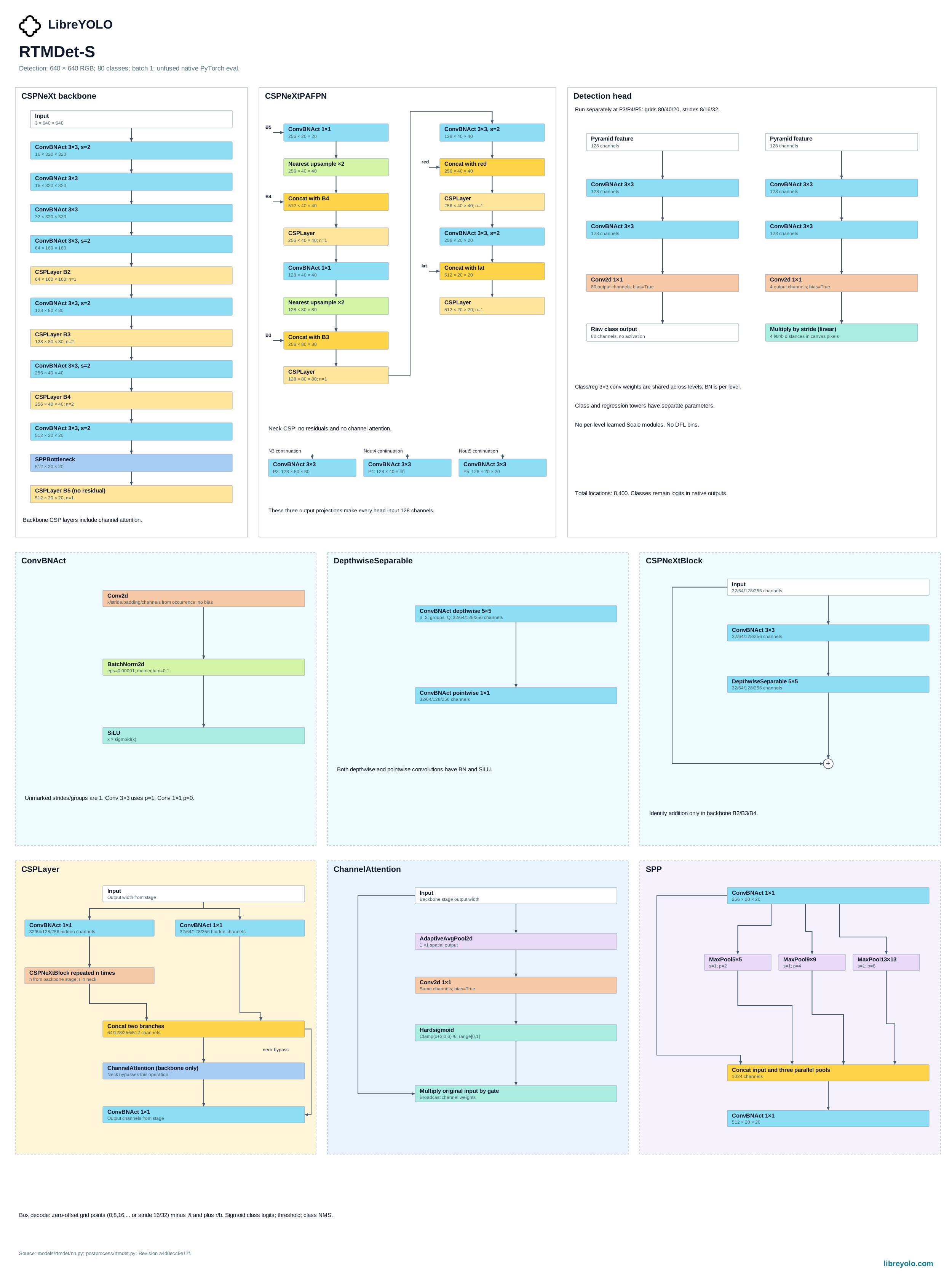
RTMDet is a single-stage detector that predicts from one point-based prior per grid location, no anchors, through a head whose convolutions are shared across feature levels. LibreYOLO supports it for detection and RTMDet-Ins instance segmentation.
- Tasks
- detection, instance segmentation
- Sizes
- t, s, m, l, x at 640 px
- Install
pip install libreyolo- Support tier
- Supported, since v. Supporting trainables: kept green in CI, features land opportunistically.
- Licenses
- Code Apache-2.0, weights Apache-2.0. Commercial use
Install
RTMDet needs no extra beyond the base package.
pip install libreyoloPredict
Weights download from Hugging Face on first use and are cached locally.
from libreyolo import LibreYOLO, SAMPLE_IMAGE model = LibreYOLO("LibreRTMDets.pt")result = model(SAMPLE_IMAGE, save=True) for box in result.boxes: print(box.cls, box.conf, box.xyxy)libreyolo predict model=LibreRTMDets.pt source=https://raw.githubusercontent.com/LibreYOLO/libreyolo/release/libreyolo/assets/parkour.jpg save=Truefrom libreyolo import LibreYOLO, SAMPLE_IMAGE # The -seg suffix in the filename selects the RTMDet-Ins mask head,# so no task argument is needed here.model = LibreYOLO("LibreRTMDets-seg.pt")result = model(SAMPLE_IMAGE, save=True) print(result.masks.data.shape)The returned Results object is the one every family returns, so swapping in a
different detector is a one line change. A -seg filename resolves to the
RTMDet-Ins task on its own, and result.masks then carries the instance
masks alongside the boxes. conf sets the confidence threshold and iou the
NMS threshold. See prediction for sources, streaming and
result handling.
Variants
Five sizes, t through x, share one architecture at a common input
resolution. This family carries no benchmark table here: compare sizes by
checkpoint file size in the table below.
Train
from libreyolo import LibreYOLO model = LibreYOLO("LibreRTMDets.pt")model.train( data="my-dataset.yaml", epochs=300, imgsz=640, batch=16, lr0=0.004,)libreyolo train model=LibreRTMDets.pt data=my-dataset.yaml imgsz=640 epochs=300 batch=16 lr0=0.004Detection trains through train(). The QualityFocalLoss, GIoU and
DynamicSoftLabelAssigner components are ported from upstream mmdetection, and
the forward pass and ONNX export are bit-equivalent to it, with postprocessing
matching mmdet's output within 0.001 mAP on val2017 subsets.
What has not been checked, per train()'s own docstring: small-dataset
fine-tune convergence, from-scratch paper parity, multi-GPU behavior, cached
Mosaic and MixUp throughput, the strict upstream two-stage pipeline switch,
and the paramwise weight-decay overrides that zero decay on norm and bias
parameters.
RTMDet-Ins has no training path. Calling train() on a -seg checkpoint, or
with task="segment", raises NotImplementedError; instance segmentation
supports inference and validation only.
train() also accepts a pretrained argument, but the value is never read
inside the method: training always continues from whatever weights the model
was constructed with, so pretrained=False does not reinitialize the
network.
Left alone otherwise, the trainer runs 300 epochs with AdamW at lr0=0.004
and weight_decay=0.05, a 1-epoch warmup on a cosine schedule, and Mosaic and
MixUp switched off for the final 20 epochs.
See training for datasets, augmentation, multi-GPU and loggers.
Validate
val() returns a dictionary of metrics/ keys covering precision, recall,
mAP 50 and mAP 50-95, measured against any dataset in the format you trained on.
from libreyolo import LibreYOLO model = LibreYOLO("LibreRTMDets.pt")metrics = model.val(data="my-dataset.yaml") print(metrics["metrics/mAP50-95"])print(metrics["metrics/mAP50"])libreyolo val model=LibreRTMDets.pt data=my-dataset.yamlfrom libreyolo import LibreYOLO model = LibreYOLO("LibreRTMDets-seg.pt")metrics = model.val(data="my-dataset.yaml") print(metrics["metrics/mAP50-95(M)"]) # masksprint(metrics["metrics/mAP50-95(B)"]) # boxesAgainst a -seg checkpoint the plain metrics/mAP50-95 key holds the mask
score, and the same run also reports boxes under (B) and masks under (M)
so both are available from one pass.
Export
| Task | ONNX | TorchScript | ExecuTorch | TensorRT | OpenVINO | Paddle | MNN | RKNN | ncnn | TFLite | CoreML | Core AI |
|---|---|---|---|---|---|---|---|---|---|---|---|---|
| Detection | Detection to ONNX: supported | Detection to TorchScript: supported | Detection to ExecuTorch: supported | Detection to TensorRT: supported | Detection to OpenVINO: supported | Detection to Paddle: not supported | Detection to MNN: not supported | Detection to RKNN: not supported | Detection to ncnn: not supported | Detection to TFLite: not supported | Detection to CoreML: not supported | Detection to Core AI: supported |
| Instance segmentation | Instance segmentation to ONNX: not supported | Instance segmentation to TorchScript: not supported | Instance segmentation to ExecuTorch: not supported | Instance segmentation to TensorRT: not supported | Instance segmentation to OpenVINO: not supported | Instance segmentation to Paddle: not supported | Instance segmentation to MNN: not supported | Instance segmentation to RKNN: not supported | Instance segmentation to ncnn: not supported | Instance segmentation to TFLite: not supported | Instance segmentation to CoreML: not supported | Instance segmentation to Core AI: not supported |
Detection exports to most formats; instance segmentation currently exports to
none of them; the matrix above reflects that split. An exported detection
artifact loads back through LibreYOLO() on its file suffix, so a .onnx or
.engine file behaves like a checkpoint and returns the same Results.
Running the graph in a bare runtime, with no LibreYOLO installed, is also
supported, but then preprocessing and postprocessing are yours to write.
from libreyolo import LibreYOLO model = LibreYOLO("LibreRTMDets.pt")model.export(format="onnx", imgsz=640)model.export(format="tensorrt", imgsz=640, half=True)libreyolo export model=LibreRTMDets.pt format=onnx imgsz=640libreyolo export model=LibreRTMDets.pt format=tensorrt imgsz=640 half=Truefrom libreyolo import LibreYOLO, SAMPLE_IMAGE # The factory routes on the file suffix, so an exported artifact loads# like any checkpoint and returns the same Results object.model = LibreYOLO("LibreRTMDets.onnx")result = model(SAMPLE_IMAGE) print(result.boxes.xyxy)Checkpoints
Every published weight file for this family.
| File | Input (px) | Weights license |
|---|---|---|
| Detection | ||
| LibreRTMDett.pt | 640 | apache-2.0 |
| LibreRTMDets.pt | 640 | apache-2.0 |
| LibreRTMDetm.pt | 640 | apache-2.0 |
| LibreRTMDetl.pt | 640 | apache-2.0 |
| LibreRTMDetx.pt | 640 | apache-2.0 |
| Instance segmentation | ||
| LibreRTMDett-seg.pt | 640 | apache-2.0 |
| LibreRTMDets-seg.pt | 640 | apache-2.0 |
| LibreRTMDetm-seg.pt | 640 | apache-2.0 |
| LibreRTMDetl-seg.pt | 640 | apache-2.0 |
| LibreRTMDetx-seg.pt | 640 | apache-2.0 |
Every file above exists in the LibreYOLO org today and downloads on first use.
Licensing
Check the license on the Hugging Face repository of the specific weights you download. Every checkpoint in the LibreYOLO org carries one, and they are not always the same across a family. That repository is the authoritative source; the summary below describes what applied when this page was last verified.
This is a description of the licenses involved, not legal advice. If the answer matters commercially, read the licenses yourself and take your own counsel.
- Original work
- RTMDet, OpenMMLab
- Upstream license
- Apache-2.0
- Upstream source
- github.com/open-mmlab/mmdetection
- LibreYOLO code
- MIT
- Weights
- Apache-2.0, republished at huggingface.co/LibreYOLO
- Interpretation
- Apache-2.0 is a permissive license, so these weights can be used in commercial and closed-source products. It asks you to keep its license text and attribution notices with any copy of the weights you redistribute, and it grants a patent license. It places no obligation on your own application code, and weights you train yourself on your own data are yours. The published RTMDet and RTMDet-Ins checkpoints are converted from mmdetection's own COCO weights, trained by OpenMMLab under the same license.
Citation
@misc{lyu2022rtmdet,
      title={RTMDet: An Empirical Study of Designing Real-Time Object Detectors},
      author={Chengqi Lyu and Wenwei Zhang and Haian Huang and Yue Zhou and Yudong Wang and Yanyi Liu and Shilong Zhang and Kai Chen},
      year={2022},
      eprint={2212.07784},
      archivePrefix={arXiv},
      primaryClass={cs.CV}
}
Copied from the authors' citation block at github.com/open-mmlab/mmdetection/tree/main/configs/rtmdet#citation.