DeepLabv3
Ein Netz für semantische Segmentierung, das Features parallel bei mehreren Dilatationsraten poolt (Atrous Spatial Pyramid Pooling), bevor es jedes Pixel klassifiziert. LibreYOLO liefert es ausschließlich für die semantische Segmentierung aus.
- Aufgaben
- semantic
- Größen
- Installation
pip install libreyolo- Supportstufe
- Nur Inferenz, seit v. Nur Vorhersage, Validierung und Export. Trainingsfunktionen sind nicht verfügbar.
- Upstream
- DeepLabv3 von PyTorch, BSD-3-Clause. Publikation, Quelle
- Lizenzen
- Code BSD-3-Clause, Gewichte BSD-3-Clause. Kommerzielle Nutzung
Installation
DeepLabv3 braucht kein optionales Extra. Alles, was es importiert, steckt in der Basisinstallation.
pip install libreyoloVorhersage
Die Gewichte werden beim ersten Aufruf von Hugging Face geladen und lokal
zwischengespeichert. Das Suffix -sem im Dateinamen ist für diese Familie
Pflicht.
from libreyolo import LibreYOLO, SAMPLE_IMAGE model = LibreYOLO("LibreDeepLabv3r50-sem.pt")result = model(SAMPLE_IMAGE, save=True) mask = result.semantic_maskprint(mask.data.shape) # (H, W) Klassen-IDsprint(mask.classes) # sortierte Klassen-IDs im Bildlibreyolo predict model=LibreDeepLabv3r50-sem.pt source=https://raw.githubusercontent.com/LibreYOLO/libreyolo/release/libreyolo/assets/parkour.jpg save=TrueDie semantische Segmentierung liefert eine Klassen-ID pro Pixel und keine
Boxen, deshalb trägt result.semantic_mask ein (H, W)-Array in .data und
die Liste der im Bild vorhandenen Klassen-IDs in .classes. conf, iou und
max_det werden aus Gründen der API-Parität akzeptiert, haben aber keine
Wirkung: Das Modell weist jedem Pixel per Argmax eine Klasse zu, ohne
Schwellenwert für die Confidence und ohne NMS-Schritt. Siehe
Vorhersage für Quellen, Streaming und den Umgang mit
Ergebnissen.
Varianten
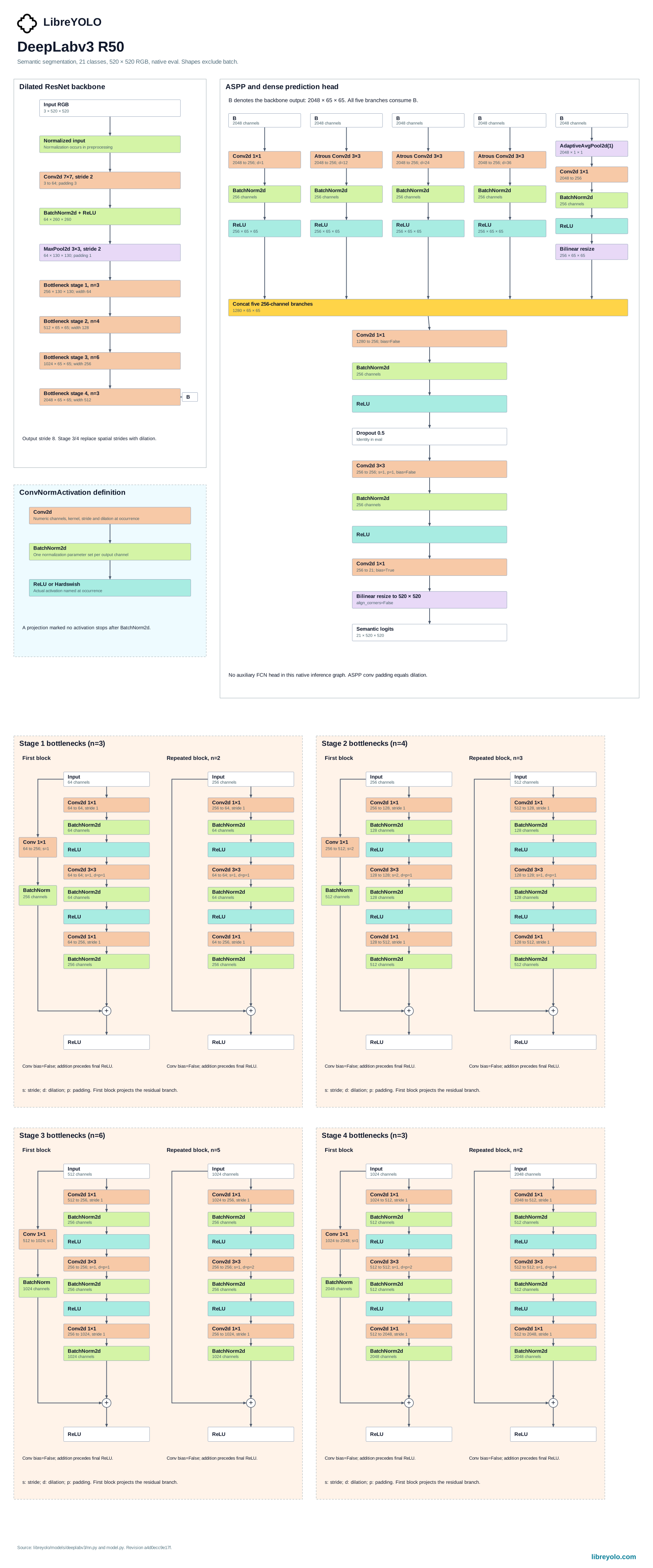
Drei Backbones: dilatiertes ResNet-50, dilatiertes ResNet-101 und dilatiertes MobileNetV3-Large. Das ist DeepLabv3, nicht DeepLabv3+, es gibt also keine Decoder-Stufe und keine CRF-Verfeinerung, passend zur Implementierung von torchvision statt zum Referenzcode des Papers selbst.
LibreYOLO trainiert DeepLabv3 nicht: train() löst für diese Familie
NotImplementedError aus, was die Support-Stufe weiter oben
als reine Inferenz kennzeichnet. Die drei veröffentlichten Checkpoints sind
torchvisions eigene Gewichte, auf COCO mit den VOC-Labels trainiert und für den
Loader von LibreYOLO konvertiert.
Validierung
val() liefert metrics/mIoU und metrics/pixel_accuracy, gemessen an jedem
Datensatz in dem Format, mit dem du trainiert hast.
from libreyolo import LibreYOLO model = LibreYOLO("LibreDeepLabv3r50-sem.pt")metrics = model.val(data="my-dataset.yaml") print(metrics["metrics/mIoU"])print(metrics["metrics/pixel_accuracy"])libreyolo val model=LibreDeepLabv3r50-sem.pt data=my-dataset.yamlExport
| Aufgabe | ONNX | TorchScript | ExecuTorch | TensorRT | OpenVINO | Paddle | MNN | RKNN | ncnn | TFLite | CoreML | Core AI |
|---|---|---|---|---|---|---|---|---|---|---|---|---|
| semantic | semantic to ONNX: unterstützt | semantic to TorchScript: unterstützt | semantic to ExecuTorch: nicht unterstützt | semantic to TensorRT: unterstützt | semantic to OpenVINO: unterstützt | semantic to Paddle: nicht unterstützt | semantic to MNN: nicht unterstützt | semantic to RKNN: nicht unterstützt | semantic to ncnn: nicht unterstützt | semantic to TFLite: nicht unterstützt | semantic to CoreML: nicht unterstützt | semantic to Core AI: nicht unterstützt |
Ein exportiertes Artefakt lädt über LibreYOLO() anhand seiner Dateiendung
wieder, eine .onnx- oder .engine-Datei verhält sich also wie ein Checkpoint
und liefert dieselben Results. Export listet die Argumente
auf, die jedes Format akzeptiert.
from libreyolo import LibreYOLO model = LibreYOLO("LibreDeepLabv3r50-sem.pt")model.export(format="onnx")model.export(format="tensorrt", half=True)libreyolo export model=LibreDeepLabv3r50-sem.pt format=onnxlibreyolo export model=LibreDeepLabv3r50-sem.pt format=tensorrt half=Truefrom libreyolo import LibreYOLO, SAMPLE_IMAGE # Die Factory entscheidet anhand der Dateiendung: ein exportiertes# Artefakt lädt wie jeder Checkpoint und liefert dasselbe Results.model = LibreYOLO("LibreDeepLabv3r50-sem.onnx")result = model(SAMPLE_IMAGE) print(result.semantic_mask.data.shape)Checkpoints
Jede veröffentlichte Gewichtsdatei für diese Familie.
| Datei | Eingabe (px) | Lizenz der Gewichte |
|---|---|---|
| semantic | ||
| LibreDeepLabv3r50-sem.pt | bsd-3-clause | |
| LibreDeepLabv3r101-sem.pt | bsd-3-clause | |
| LibreDeepLabv3mv3-sem.pt | bsd-3-clause | |
Jede oben aufgeführte Datei ist heute in der LibreYOLO-Organisation verfügbar und wird bei der ersten Verwendung heruntergeladen.
Lizenzierung
Prüfe die Lizenz im Hugging-Face-Repository der konkreten Gewichte, die du herunterlädst. Jeder Checkpoint in der LibreYOLO-Organisation hat eine Lizenz, und sie ist innerhalb einer Familie nicht immer gleich. Dieses Repository ist die maßgebliche Quelle. Die Zusammenfassung unten beschreibt den Stand bei der letzten Verifizierung dieser Seite.
Dies ist eine Beschreibung der beteiligten Lizenzen und keine Rechtsberatung. Wenn die Antwort kommerziell relevant ist, lies die Lizenzen selbst und hole eigenen Rechtsrat ein.
- Originalarbeit
- DeepLabv3, PyTorch
- Upstream-Lizenz
- BSD-3-Clause
- Upstream-Quelle
- github.com/pytorch/vision
- LibreYOLO-Code
- MIT
- Gewichte
- BSD-3-Clause, erneut unter huggingface.co/LibreYOLO veröffentlicht
- Einordnung
- BSD-3-Clause is a permissive license, so this code and these weights can be used in commercial and closed-source products. It asks you to keep the copyright notice, license text and a non-endorsement clause with any copy you redistribute. LibreYOLO's inference graph is torchvision's ASPP head over its ResNet-50, ResNet-101 and MobileNetV3-Large backbones; it is DeepLabv3, not DeepLabv3+, so there is no decoder or CRF, and the paper's training-only auxiliary FCN classifier is excluded. The three published checkpoints are torchvision's official COCO-with-VOC-label weights; their separate LibreYOLO Hugging Face mirrors carry BSD-3-Clause on an implied basis disclosed by torchvision rather than an explicit checkpoint-specific grant, and torchvision's own documentation notes that pretrained-model terms can depend on the training data, leaving that determination to the user.